
Workspace intelligence
Workspace intelligence gives operators and agents one bounded answer to
the question “what’s going on across this workspace right now?” without
opening a separate inspector for each subsystem. It composes cartographer
posture, stigmergy heat, enforcement status, and workstream signals into a
single read-only workspace_intelligence JSON packet, delivered on
workspace_snapshot, GET /v1/workspace-environment, and MCP
bmo_get_workspace_snapshot.
It does not authorize mutation, replace file reads, or assert filesystem truth. Individual slices (heat, markers, trail, signal pressure) remain the drill-in surfaces when you need raw detail.
Maturity: Advanced advisory surface. Use it when you want a single cross-subsystem summary before opening cartography, stigmergy explain, or enforcement deposit flows.
What the packet contains
Section titled “What the packet contains”Each packet (workspace-intelligence-packet/v1) may include independent
source entries with their own freshness and degradation:
| Source | What it summarizes |
|---|---|
cartographer | Bounded living-architecture evidence when zone paths overlap generated proof |
workspace_strategy | Cross-session strategy memory posture for the workspace |
stigmergy | Signal-fabric pressure and zone context for the scoped glob |
enforcement | Substrate posture and active primitives when enforcement is enabled |
workstreams | Open workstream / review context when scoped |
change_throughput | Parallel-writer advisory totals and deposit follow-through telemetry |
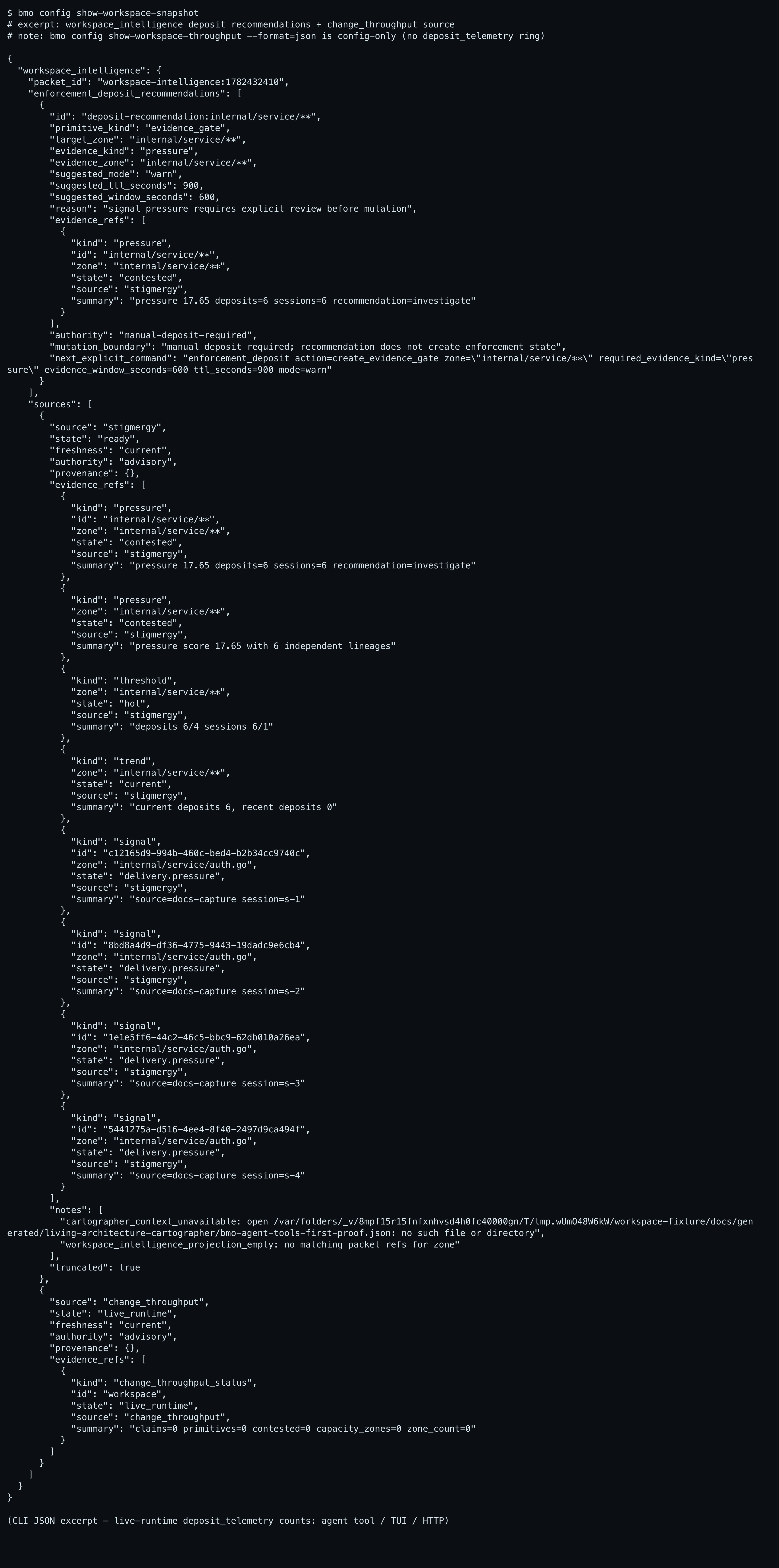
The packet may also carry enforcement_deposit_recommendations: advisory
suggestions naming a primitive kind, target zone, evidence refs, and suggested
mode/TTL with authority manual-deposit-required. These are not
deposits — use the existing enforcement_deposit surface explicitly when you
act.
Optional intelligence_lifecycle on the parent workspace snapshot reports
cross-surface readiness vocabulary (cold, warming, ready, degraded,
stale, absent, unknown) when lifecycle producers are attached (for example
LSP and in-flight analyzer work; verify-run may appear on dedicated verify
trailers rather than every snapshot read). Lifecycle metadata is advisory; it
does not block reads or authorize mutation.
When to open what
Section titled “When to open what”Use this routing before diving into a single tab or tool:
| Question | Start here |
|---|---|
| Is the observer healthy? | /workspace-snapshot |
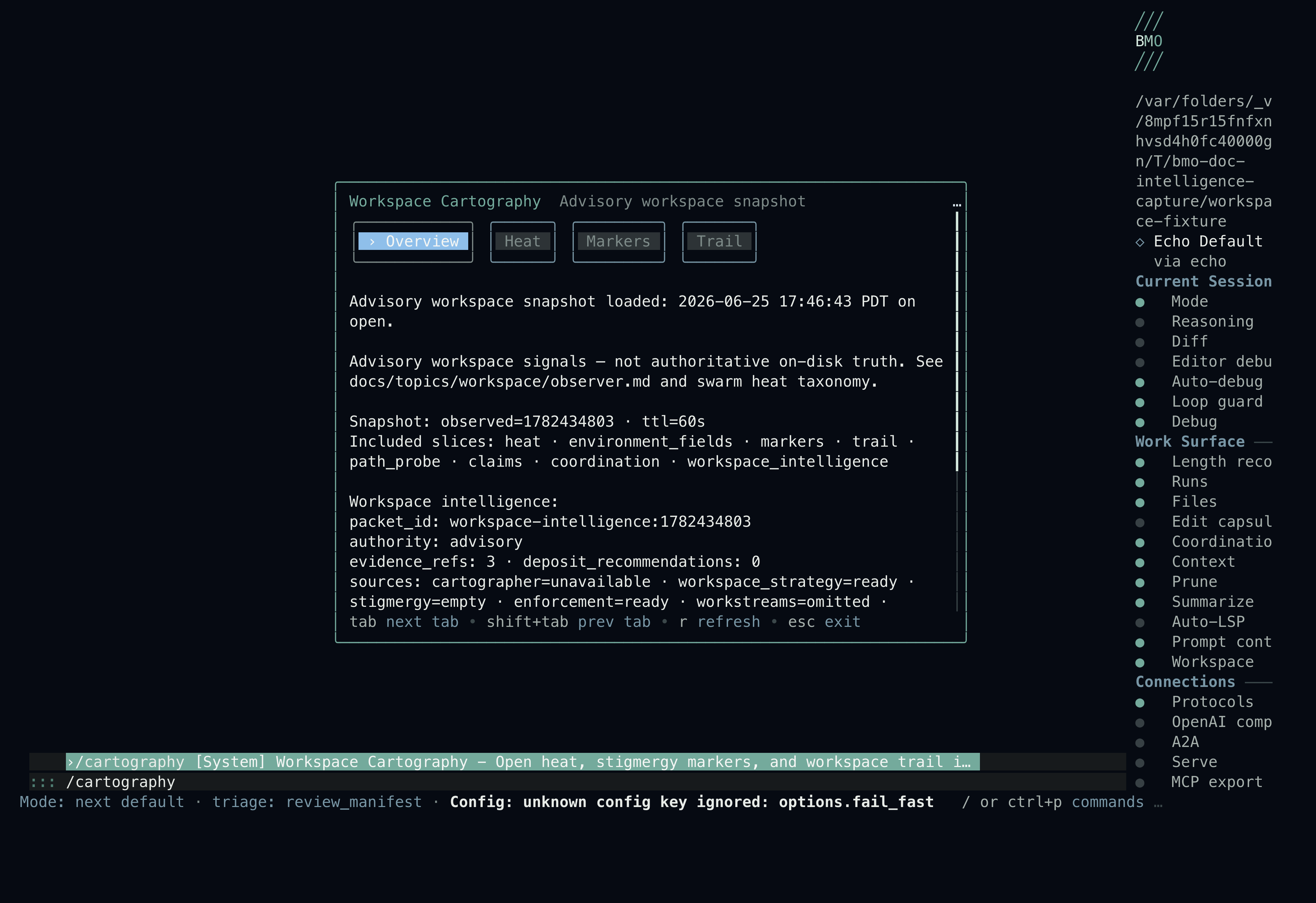
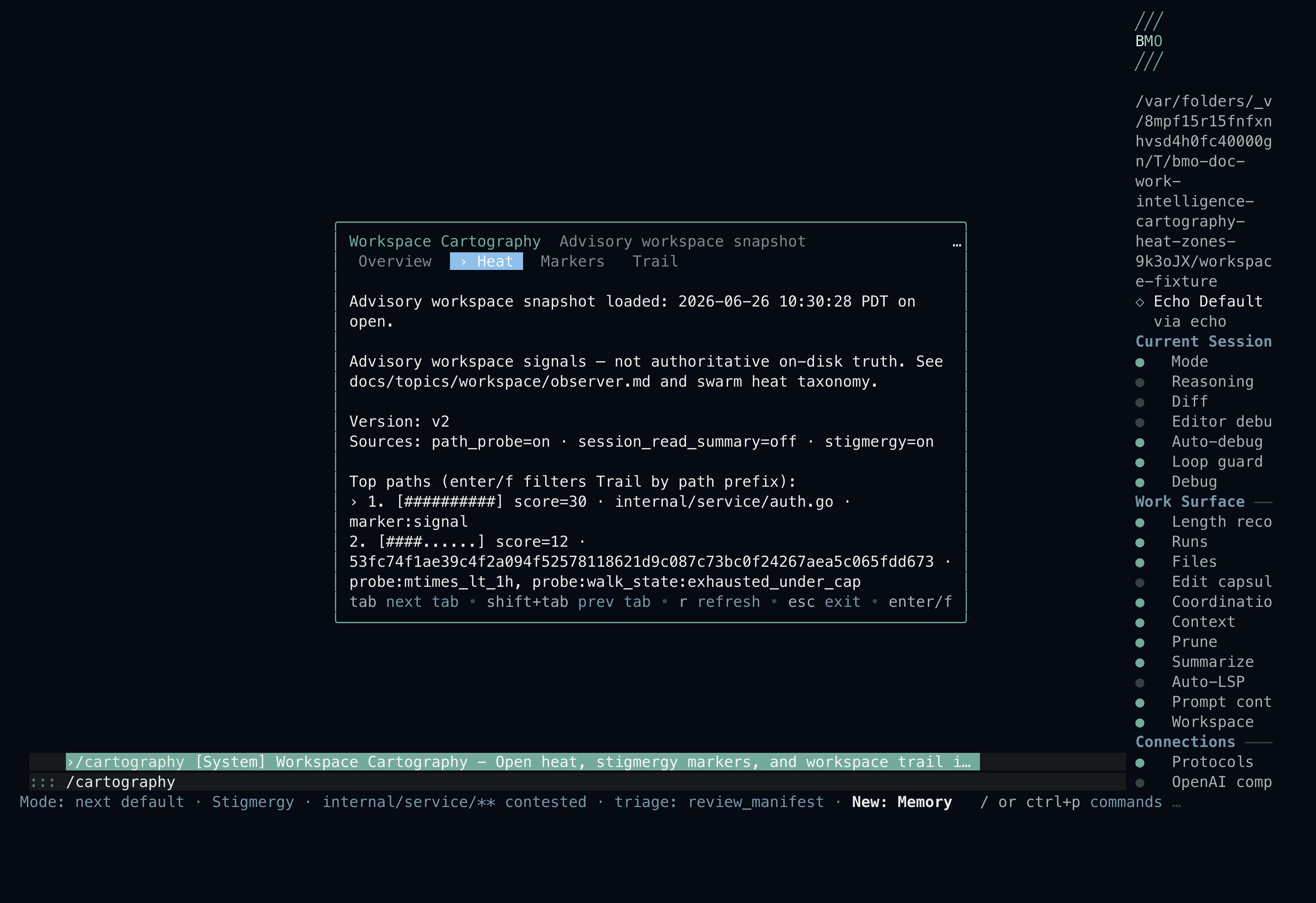
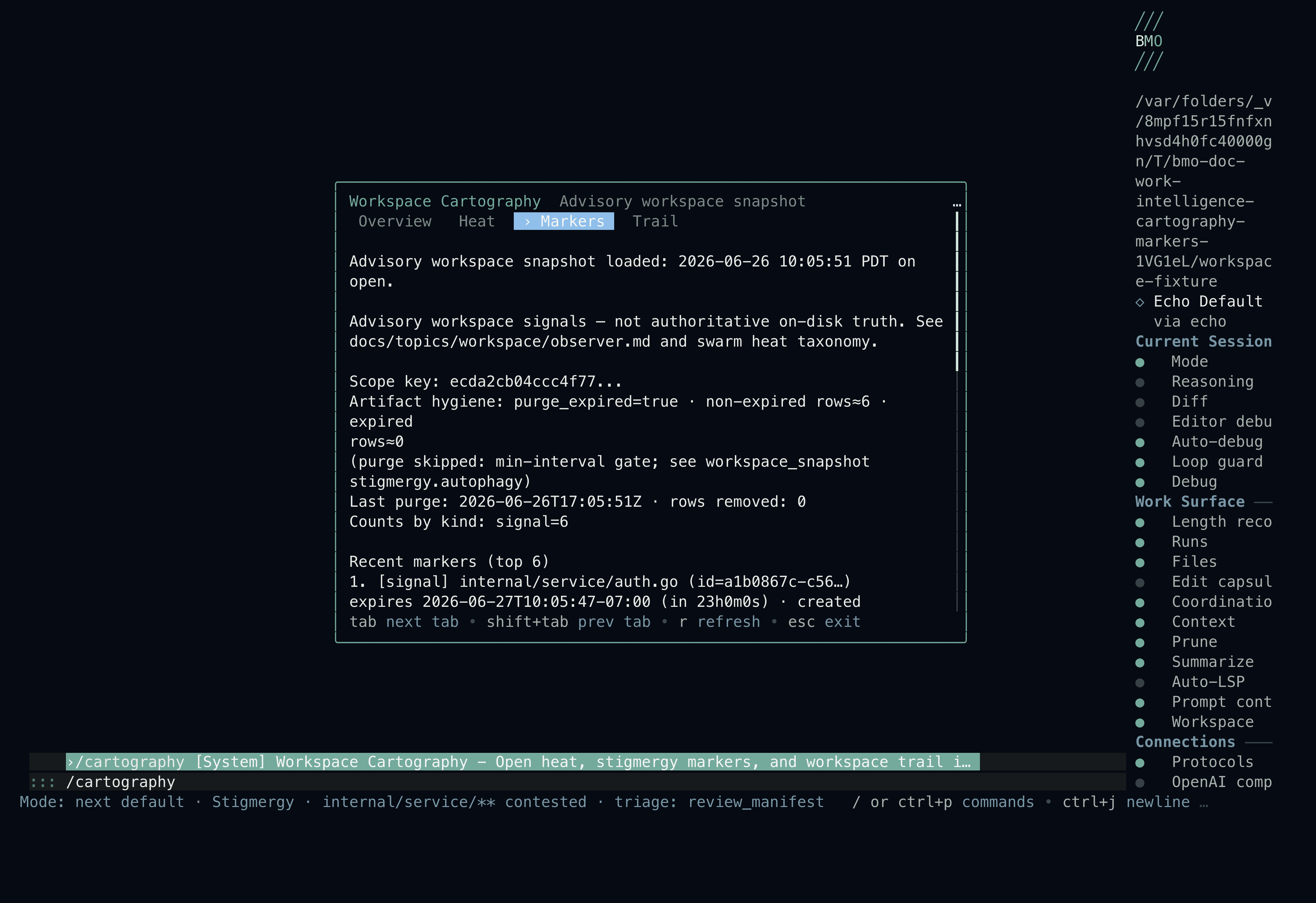
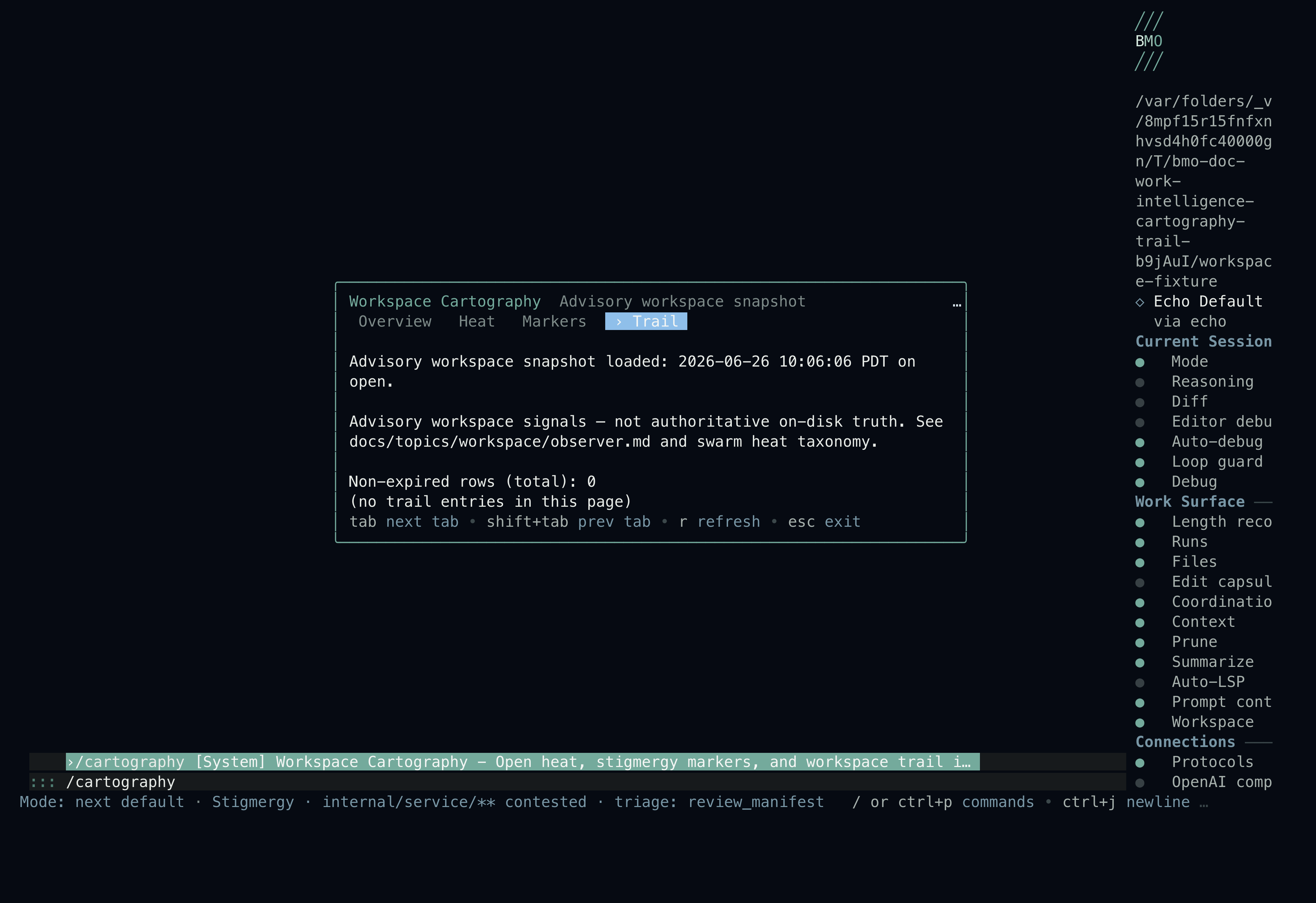
| Where is pressure spatially? | /cartography (Overview · Heat · Markers · Trail) |
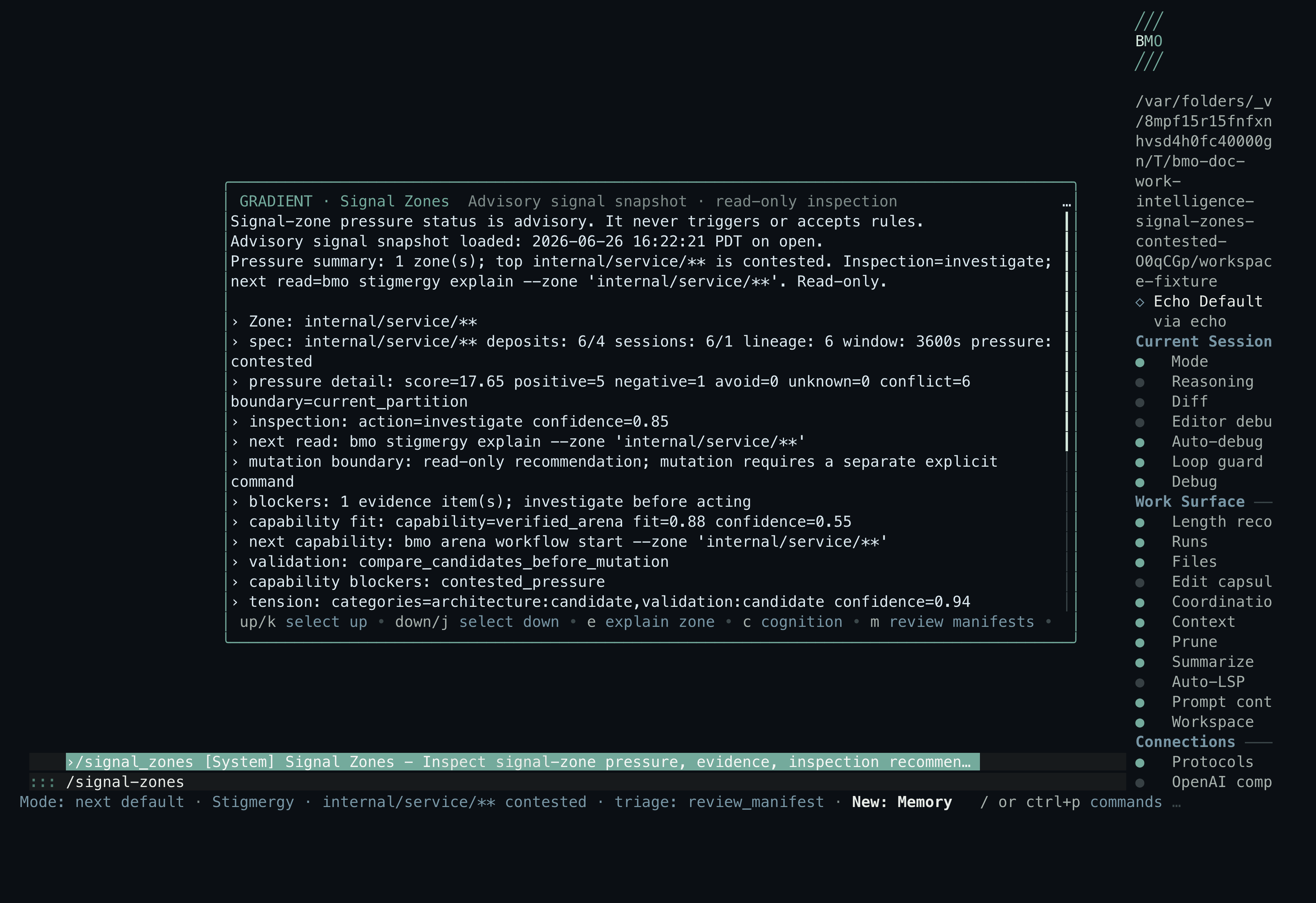
| Which zones are hot or contested? | GRADIENT · signal zones — /signal-zones, bmo signal zones |
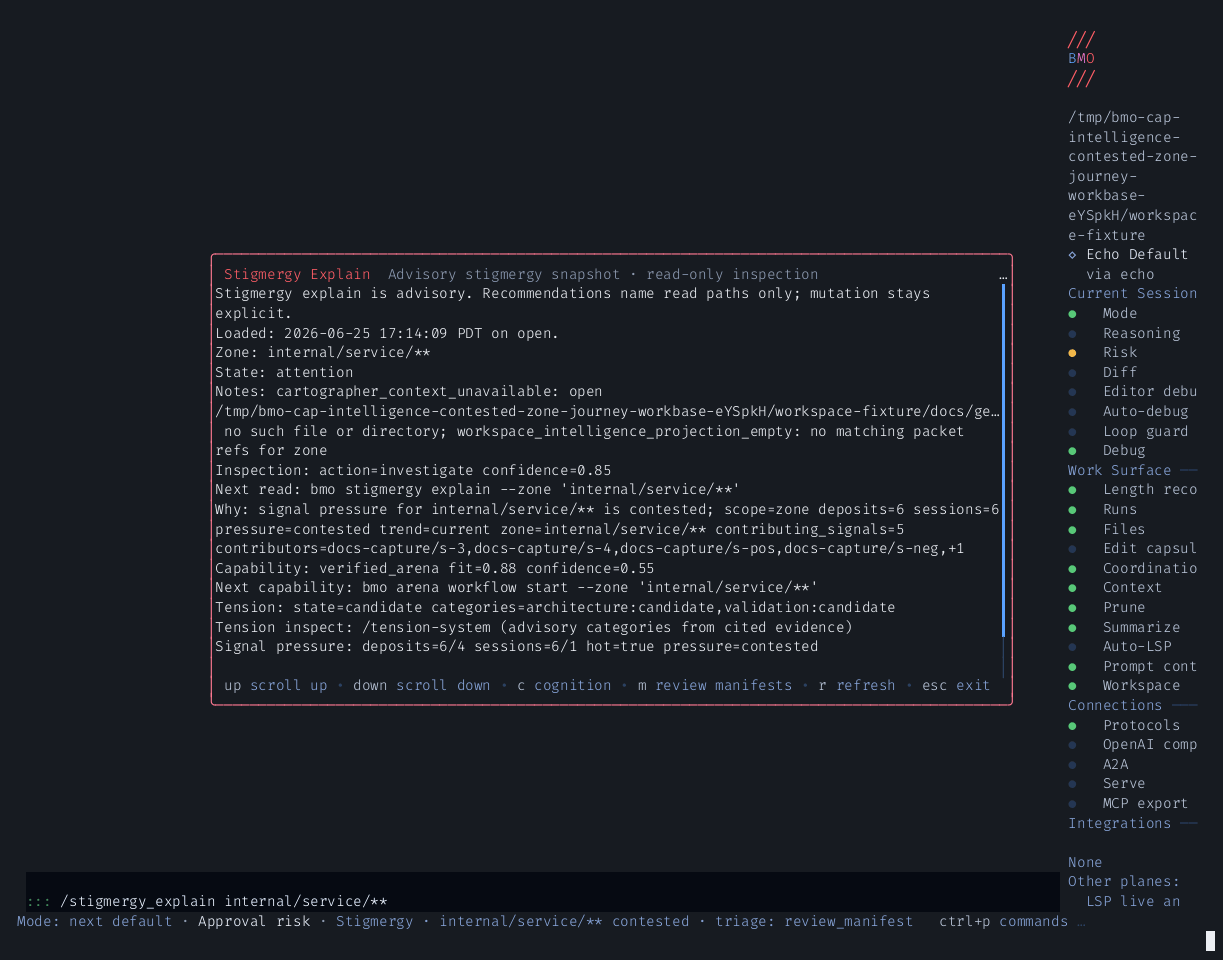
| Why does this zone matter? | bmo stigmergy explain or /signal-zones |
| What tension categories apply? | bmo stigmergy explain embedded tension_manifest or tension topic |
| Parallel writers / claims? | /workspace-throughput |
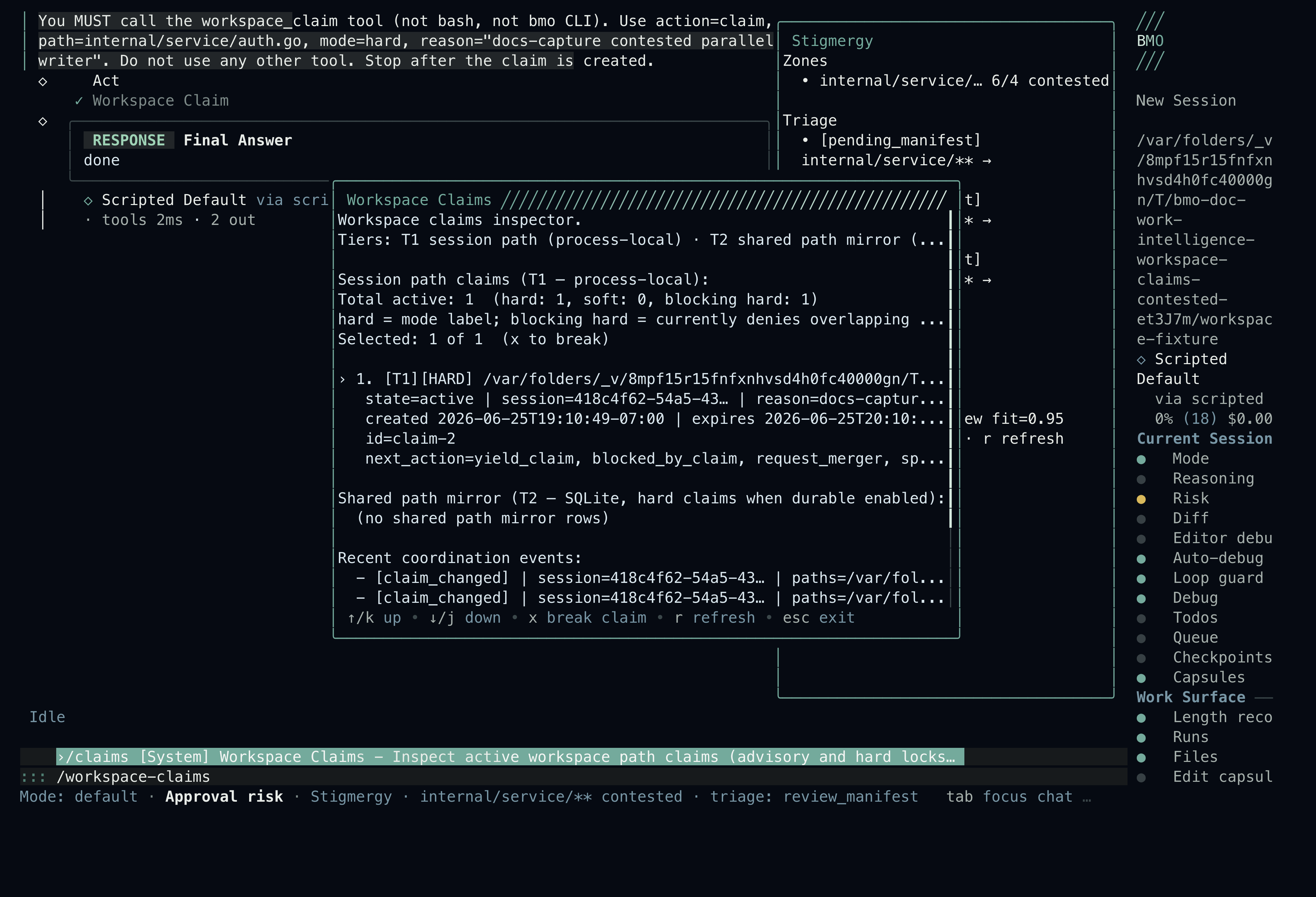
| Path claim overlaps? | /workspace-claims |
| Should I deposit enforcement? | /enforcement — packet recommendations are hints only |
Operator surfaces
Section titled “Operator surfaces”| Surface | Entry |
|---|---|
| Agent tool | workspace_snapshot — read workspace_intelligence and optional intelligence_lifecycle keys |
| HTTP | GET /v1/workspace-environment (Bearer auth) |
| MCP | bmo_get_workspace_snapshot (list in services.mcp.exposed_tools; not exposed by default) |
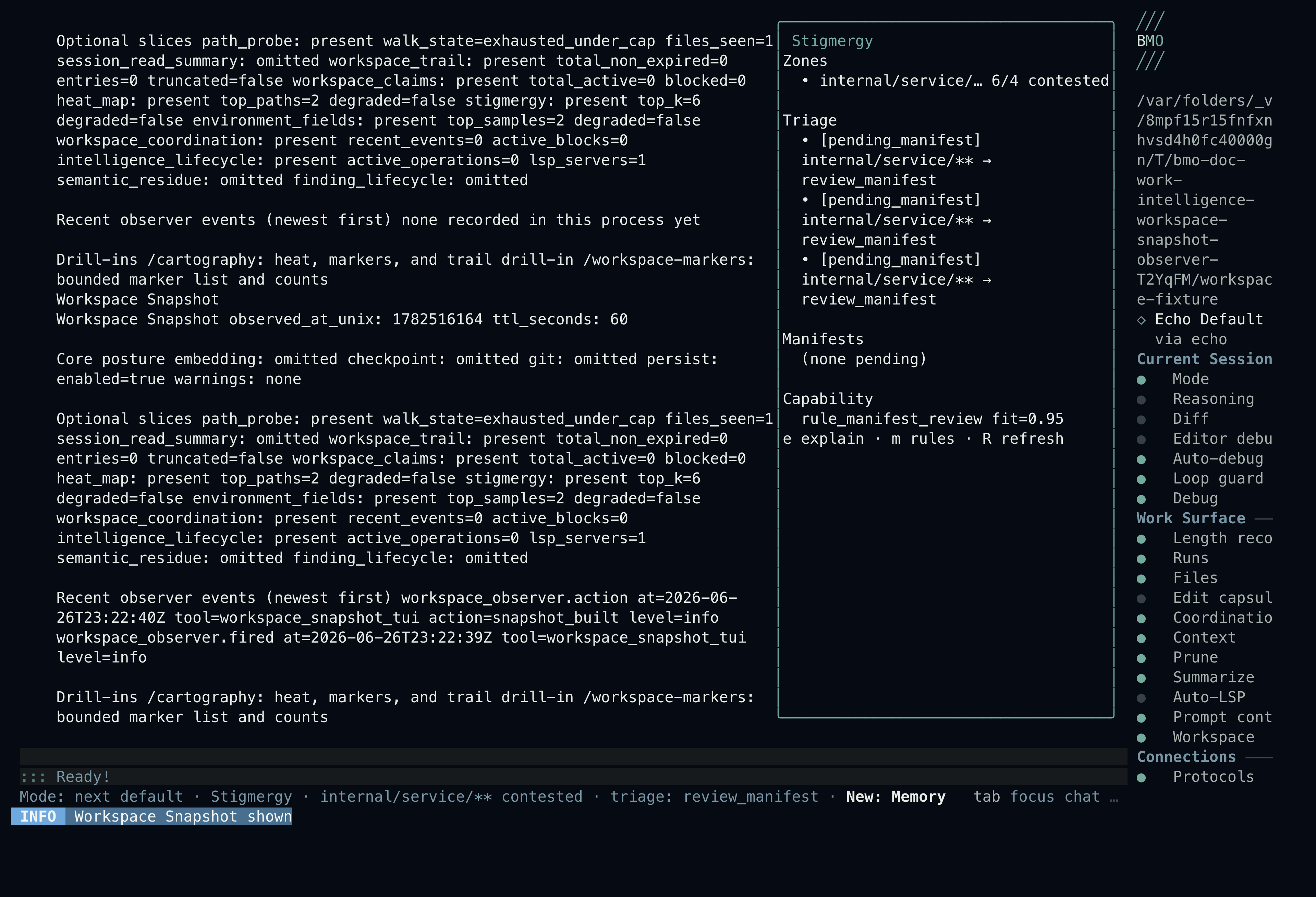
| TUI | /workspace-snapshot → links to /cartography; cartography Overview synthesizes the packet |
| CLI | bmo config show-workspace-snapshot; bmo workspace preflight |
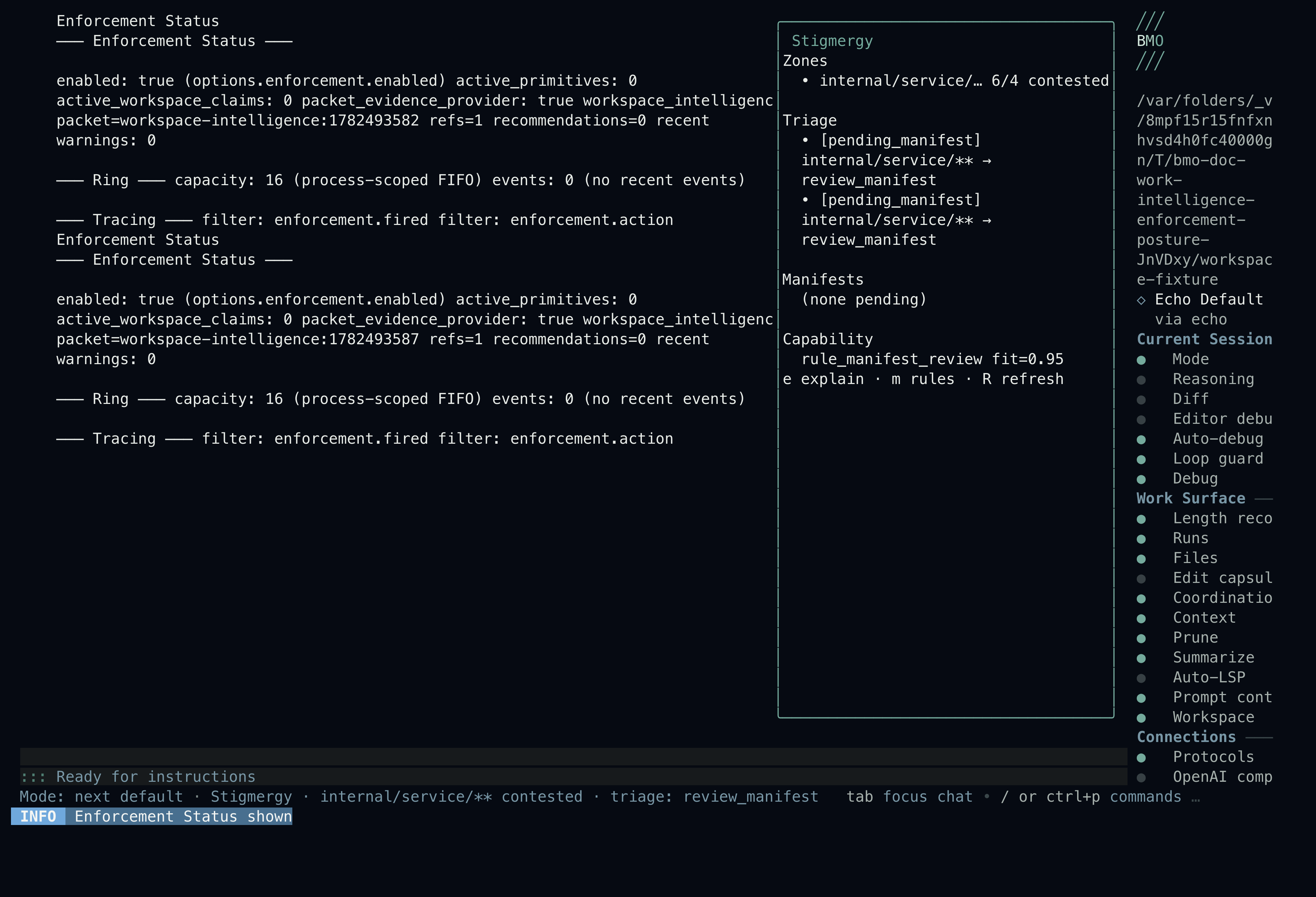
Stigmergy explain/triage/zones compose a deeper capability readout on Stigmergic delivery; the workspace intelligence packet is the snapshot-local composition hub.
Configuration
Section titled “Configuration”Most sources read persisted or in-process state; there is no single
options.workspace_intelligence block. Enable the underlying producers:
[options.workspace_observer]# enabled = true  # default; required for snapshot root
[options.workspace_markers]# enabled = true  # default-on; set false to opt out
[options.signal_fabric]# enabled = true  # default-on; set false to opt out
[options.enforcement]enabled = true  # off until enabled; source + deposit recommendations when on
[options.workspace_strategy_memory]# enabled = true  # default; strategy source in packet
Cartographer context appears when generated proof exists and zone paths overlap
evidence. Its packet source also reports advisory posture: ready, stale,
unavailable, malformed, or empty, plus bounded source/projected counts and proof
provenance (task cartographer:generate for maintainers). See the
configuration reference for merge precedence.
Work intelligence substrate (deeper readouts)
Section titled “Work intelligence substrate (deeper readouts)”When you pass workstream_id or session_id to stigmergy explain,
triage, or signal zones, BMO may attach substrate evidence: patch proposals,
review findings, arena candidates, and memory hints. That composition is
read-only with explicit_only mutation on capability guidance.
Advanced intent/influence substrate lanes are maintainer-documented only — see Workspace intelligence topic.
Start with Stigmergic delivery for the operator loop; use this page when you need the snapshot packet contract.
Scenario captures
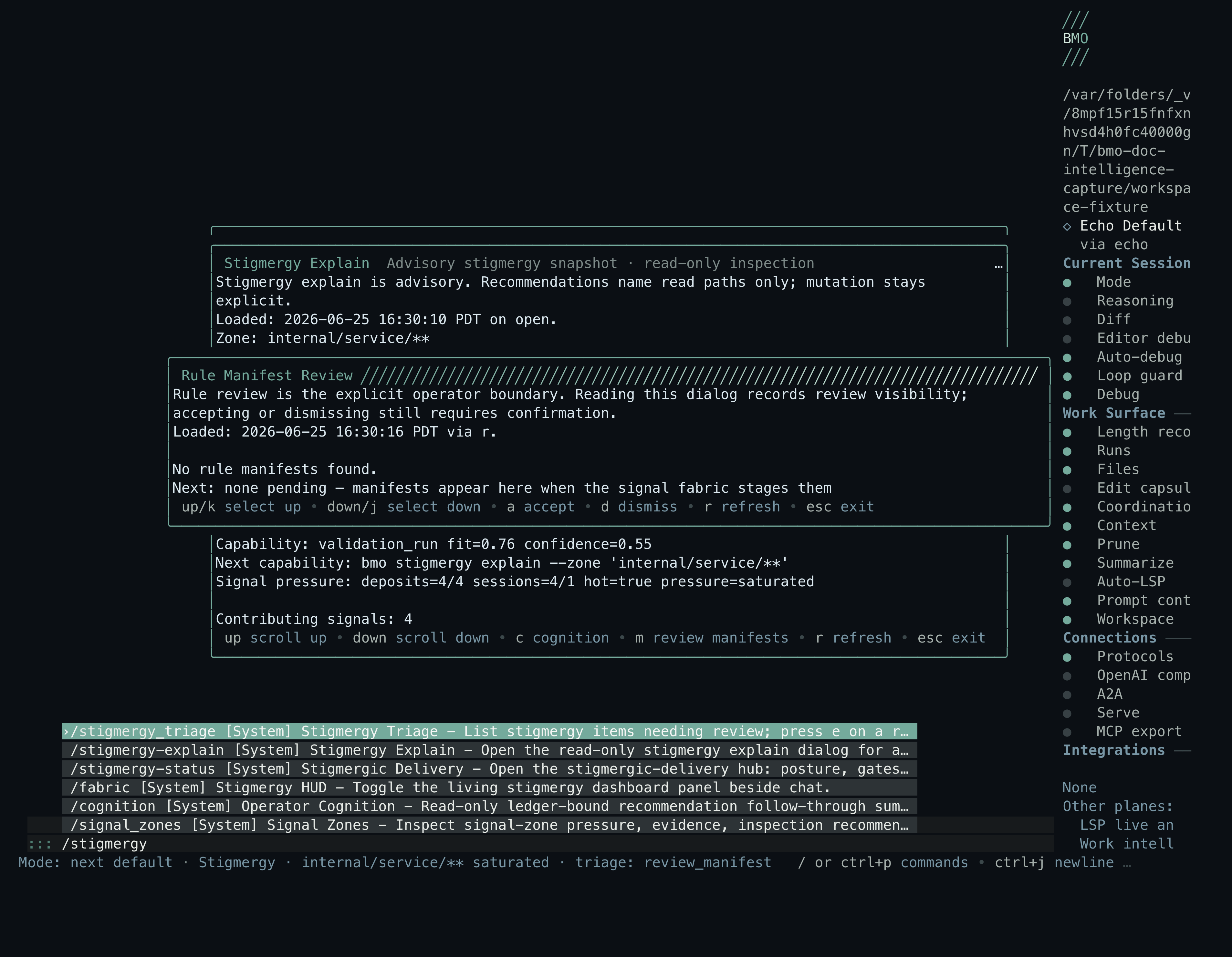
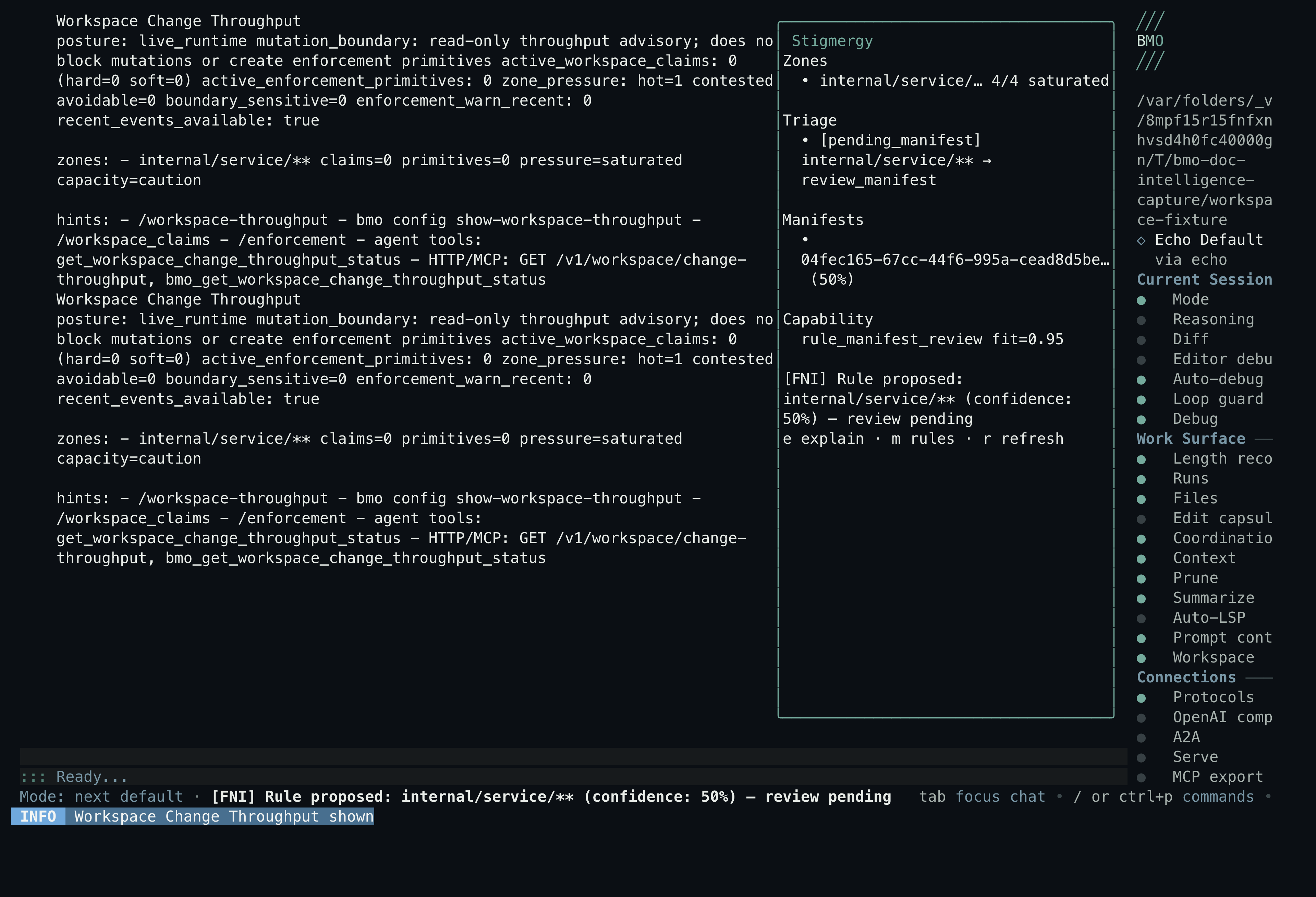
Section titled “Scenario captures”Echo-seeded tmux captures document the routing story above. The journey recording shows hub → zones → explain; the explain PNG is the final frame only. Deposit follow-through uses the JSON excerpt capture (not the throughput TUI). Maintainer beat specs: intelligence scenario corpus (anchor: contested parallel delivery — swappable for adjacent domains).
Related
Section titled “Related”- Workspace observer — snapshot root and observer TTL
- Workspace trail — markers and cross-session hints
- Workspace strategy memory — one packet source
- Stigmergic delivery — GRADIENT / REACT loop and explain/triage
- Tension manifests — inspect family and embedded manifests in explain
- Enforcement substrate — deposit actuation (separate from recommendations)
Maintainer detail
Section titled “Maintainer detail”Workspace intelligence topic — packet schema, substrate merge order, lifecycle contract, and conformance tests.
Operator routing — taxonomy, trust boundaries, and maintainer cadence (routing table lives on this page).