
Session Compaction
Session compaction is BMO’s foreground context-window recovery path. When a live session approaches the model’s context limit, BMO compacts the conversation so active work continues without losing bounded continuity state — and never trusts a summary it has not first proven safe.
This page is about the foreground session-recovery meaning of compaction. For idle-gated background upkeep, see Compaction (idle-gated automation). The two are distinct: session compaction runs inline against the run you are in right now, driven by prompt-budget pressure; the compaction swarm is idle-gated work that never competes with a foreground turn.
flowchart TD
    pressure["Prompt budget pressure"] --> mech["Phase 1 - mechanical summary (instant, no LLM)"]
    mech --> trusted["Trusted continuation source"]
    mech --> shadow["Derive retention shadow (load-bearing facts)"]
    mech -. optional .-> sem["Phase 2 - semantic summary (background LLM)"]
    sem --> gate{"Retention quality gate"}
    shadow --> gate
    gate -->|all probes survive| swap["Commit-safe hot-swap"]
    gate -->|drop / truncate / mismatch| reject["Reject - keep mechanical"]
    swap --> posture["Bounded posture and reason codes"]
    reject --> posture
    trusted --> posture
    posture --> readouts["session status, describe_context, app read model"]
When to use it
Section titled “When to use it”Use session compaction when a long-running conversation is approaching the model’s context window and you want BMO to preserve continuity instead of failing on length alone. It is most valuable on:
- long implementation sessions that accumulate many tool calls and file edits
- sessions under provider pressure where the prompt budget is tightening
- work where dropping a single load-bearing fact (an active goal, a permission boundary, an open file path) would silently corrupt the continuation
It does not have to be invoked manually; the auto-summarize trigger fires near the limit when enabled.
How it works
Section titled “How it works”Session compaction is a two-phase model. The first phase is always trusted; the second must earn its place.
Phase 1 — mechanical (always the trusted continuation source)
Section titled “Phase 1 — mechanical (always the trusted continuation source)”The mechanical phase is instant, deterministic, and uses no LLM. It extracts structured facts directly from the transcript — file paths, errors, user goals, instructions, provider pressure, decision state, validation results, and tool-call summaries — and keeps a verbatim window of the most recent turns. Because it is deterministic it is always available and always safe, so BMO treats it as the trusted continuation source and measures every later decision against it.
Phase 2 — semantic (optional, must earn trust)
Section titled “Phase 2 — semantic (optional, must earn trust)”The semantic phase is an optional background LLM summary that runs after Phase 1, inline or on a background goroutine. Only one runs at a time: a newer compaction cancels an in-flight one, and stale results are rejected by a monotonic version guard. A fluent semantic summary is never trusted on appearance alone — it must pass the retention quality gate before it can replace the mechanical summary.
Retention quality gate
Section titled “Retention quality gate”Phase 2 is validated against a bounded retention shadow of load-bearing
facts derived from the mechanical summary. There are nine fact classes:
active_goal, user_constraint, permission_boundary, active_path,
tool_outcome, provider_pressure, decision_state, validation_result, and
summary_link.
The policy is two-tier:
- Majority classes —
active_goalandactive_path— require at least 50% coverage and are paraphrase-tolerant, so reworded but faithful summaries pass. - Fail-closed classes — every other class — must survive in full. A single dropped load-bearing fact rejects the semantic summary.
Other rejection triggers are equally strict: empty content, a missing or
max_tokens stop reason (semantic_truncated), a turn-range mismatch, a zero
token count, or a retention ratio greater than 1.0.
Fail-closed fallback
Section titled “Fail-closed fallback”If the semantic summary is unsafe or unclassifiable, BMO keeps the mechanical summary. This is intended behavior: fluent semantic output can still be rejected. A summary that reads well but quietly dropped a permission boundary is more dangerous than a terse mechanical one, so the gate fails closed.
Commit-safe hot-swap
Section titled “Commit-safe hot-swap”When a semantic summary does pass, the swap is peek → persist → commit. BMO peeks the ready semantic content and its version without consuming it, updates the linked summary message, and only commits the swap if the version still matches. A failed persist falls back to the mechanical summary rather than losing both. If the summary-message link is missing, the swap is deferred.
Speculative pre-compaction (retired)
Section titled “Speculative pre-compaction (retired)”There is no speculative pre-compaction. The mechanism was implemented but never reachable: its staged results had no production consumer, so nothing it produced ever reached a prompt. It was removed rather than left half-wired. Compaction fires from the summarization thresholds below.
Bounded posture and reason codes
Section titled “Bounded posture and reason codes”Every read surface projects a bounded posture vocabulary and bounded reason codes. Raw transcript content and provider response bodies never leak through these surfaces — posture evidence is metadata-only. A broken summary link is surfaced before any streaming phase, so you learn about a continuity gap up front instead of mid-stream.
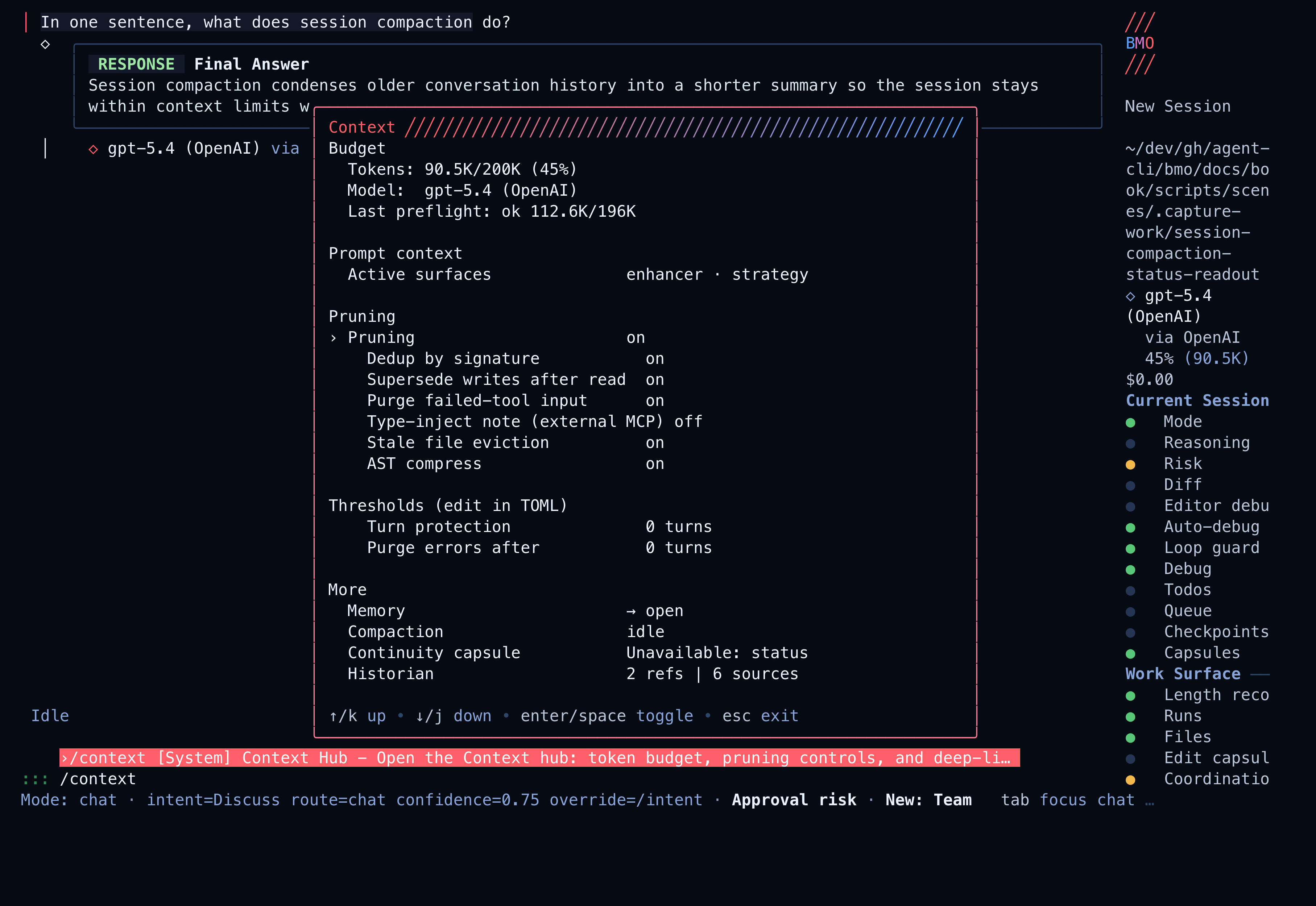
Posture is read through describe_context / the Context hub, bmo session status, and the app read model. All three share one vocabulary; see
Session compaction parity for the full
list of states and reason codes.
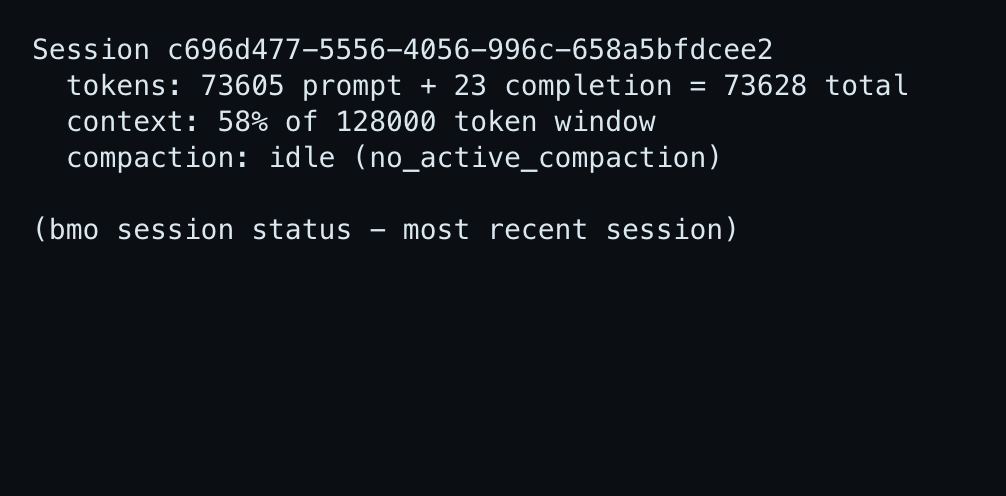
No single TUI screen renders the whole posture vocabulary at once — posture is a
per-session projection, and any given session sits in exactly one state. The
readout below is one real instance captured from the running CLI rather than a
diagram of the taxonomy: bmo session status prints the bounded posture line for
a live session (here the resting idle state, before any prompt-budget
pressure). Every other state in the vocabulary prints on this same line; read it
alongside the full list in
Session compaction parity.
Configuration
Section titled “Configuration”The automatic trigger is controlled by:
options.enable_auto_summarizeoptions.summarization.enabledoptions.summarization.context_window_bufferoptions.summarization.context_window_ratio
Round-pressure admission thresholds live under
options.compaction.streaming — despite the names, this block does not
configure the streaming compactor:
precompact_threshold(default 0.7) — headroom fraction for diagnostic recovery admission, not a speculative triggerprecompact_window(default 20) — completed-tool-round deny threshold
A separate, similarly named block — options.streaming_compaction — carries its
own precompact_window, semantic_enabled, semantic_timeout, and
latency_budget keys with different defaults and different consumers. Nothing copies values between the two blocks, so setting a
key on one surface never changes the other’s behavior:
| Block | Consumer | Note |
|---|---|---|
options.compaction.streaming | provider-turn round-pressure admission | Seconds-valued integers; thresholds only. |
options.streaming_compaction | the foreground session compactor constructed per session | Duration strings ("60s", "500ms"); enabled, semantic_enabled, and the timeouts live only here. |
Latency-budget and semantic timeout/enable settings belong to
options.streaming_compaction. They were previously also accepted under
options.compaction.streaming, where they reached no consumer. They are now
retired: setting one under options.compaction.streaming fails config load
with a message naming the working surface, rather than silently doing nothing.
Set the block whose consumer you mean to change. Routing is pinned by regression tests so that each block reaches only its intended surface.
For exact fields and defaults, see Configuration.
What you see in BMO
Section titled “What you see in BMO”| Surface | Purpose |
|---|---|
summarize_session | Manual session compaction on demand |
bmo session status | Session budget and shared compaction posture |
describe_context / Context hub | Summary-link health, continuity state, and recent compaction evidence |
What it is not
Section titled “What it is not”Session compaction is not:
- the idle-gated
builtin://compactionexecutor - scheduler or nap-controller background work
- branch or PR promotion
- the
/compactionreaction-gate inspector by itself - a path that trusts semantic summaries by default — the mechanical summary is always the fallback
Related
Section titled “Related”- Sessions — continuity hub for choosing between a new session, branch, checkpoint, restore, and compaction.
- Compaction (idle-gated automation)
- Session compaction parity
- Tools Reference
- MCP Server
- Implementation notes: Session compaction topic