
Nanites
Nanites are background micro-runs: short, budget-bounded child runs that BMO can run in a separate lane from the current foreground conversation. They are useful when a task should be explored, checked, summarized, or handed off without turning the main session into a long blocking run.
Maturity: Advanced operator surface. Use nanites after the main workflow model is clear; the Morphogen evidence described below is eval-only and does not change runtime authority.
What problem this solves
Section titled “What problem this solves”Long agent sessions often collect small follow-up tasks: inspect a risky area, summarize a branch, check a workstream, run a quick review pass, or gather supporting context. Running all of that in the main chat creates three problems:
- Attention contention: the foreground conversation waits while a side task works.
- Budget ambiguity: small background checks can consume the same turn budget as the main task.
- Handoff loss: useful side-run results can disappear into chat text instead of becoming workstream state.
A nanite gives those tasks a small child run with its own capacity guard and a clear parent-session handoff.
Use it when
Section titled “Use it when”- You want a quick bounded review, search, summary, or verification pass while preserving the main session.
- The work belongs to the same parent session or workstream but does not need live steering.
- You want the result recorded as
last_nanite_*on the parent workstream when the parent is workstream-bound. - You need tighter spend or recovery behavior than a general foreground run.
Do not use it when
Section titled “Do not use it when”- The task needs active conversation, iterative steering, or approval before each step.
- The task may make broad edits without a separate worktree or explicit safety plan.
- You need a long-running agent with its own durable plan lifecycle; use staged workflow, recipes, or a normal child agent instead.
How it behaves
Section titled “How it behaves”Nanites are not just renamed subagents. They run through the same child-run machinery, but reserve capacity from the nanite lane rather than the regular subagent lane. That means a foreground agent can still spawn regular child agents while nanites are capped separately by configuration.
bmo nanite run is the approval event for an unattended, code-capable child.
That command requires an isolated worktree, then may use the coder tool list
without asking for every tool approval. Authenticated HTTP enqueue and the
opt-in MCP enqueue tool stay on the task tool set in plan mode and do not
auto-approve. In the default local backend, operator-started tools run with the
privileges of the user running BMO. The isolated worktree is not a security
sandbox.
Authority boundary:
bmo nanite runmeans approval for unattended tool use inside the configured runtime. Report unauthorized enqueue, auto-approval on HTTP or MCP nanite children, a nanite without an isolated worktree, execution outside workspace policy, or privilege/scope expansion. Model-chosen tool use insidebmo nanite runis accepted risk by itself; see Security posture.
Key distinctions:
| Behavior | Nanite | Spawned subagent |
|---|---|---|
| Typical entry | bmo nanite run / bmo micro-run run | spawn_agent tool |
| Capacity guard | options.nanite_max_threads | options.agent_max_threads and per-agent delegation caps |
| Default budget | build_budget_presets.nanite | options.subagent_build_budget_preset or explicit child config |
| Approval posture | bmo nanite run auto-approves after an isolated worktree is created. HTTP and MCP enqueue stay in plan mode | Depends on child run params and session policy |
| Parent handoff | workstreams.last_nanite_* when bound | Child output remains attached to the parent run/session |
| Best fit | bounded background check | interactive or tool-driven delegation |
Quick example
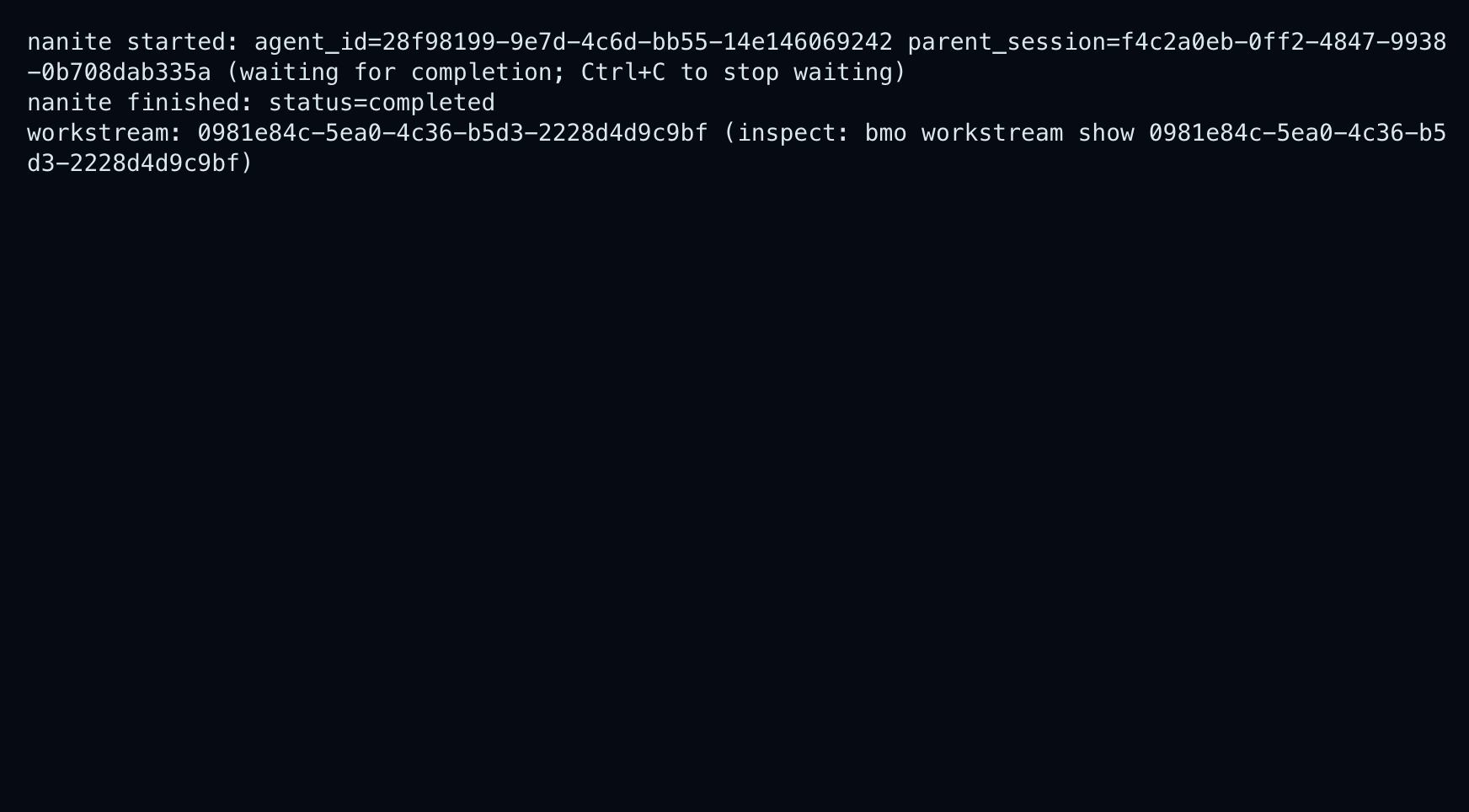
Section titled “Quick example”bmo nanite run --session <parent-session-id> "quickly inspect the recent diff for obvious config drift"Use the same data directory as the TUI when you want the child run to bind to the active parent session:
bmo -D ~/.local/share/bmo nanite run --session <parent-session-id> "summarize the current workstream status"What you should see
Section titled “What you should see”If the parent session is attached to a workstream, bmo workstream show <id> includes the most recent nanite handoff fields after completion:
| Field | Meaning |
|---|---|
last_nanite_at | Completion timestamp |
last_nanite_status | Terminal child status |
last_nanite_child_session_id | Child session id |
last_nanite_agent_id | Child agent id |
last_nanite_excerpt | Short output or error excerpt |
Evaluation evidence
Section titled “Evaluation evidence”Nanite enqueue is also an evidence surface for BMO’s internal Morphogen
signal-fabric evaluation. When workspace stigmergy and mycelial gradient context
shape a nanite prompt, BMO records a bounded morphogen.signal_decision
annotation in the durable run ledger. Direct CLI, HTTP, and MCP nanite enqueue
paths use the same app-owned run-ledger observation path, so
bmo eval morphogen can inspect persisted parent and child run evidence after
the micro-run.
This evidence loop is not a user-facing control surface and it does not bypass
permissions, create goals, block edits, or merge code. The annotation metadata
is intentionally compact: the stable key is decision_key, and the record also
includes parent session id, child session id, child agent id, decision status,
evidence class, and bounded source scope for domain classification. The bounded
domain is biomimetics-docs; out-of-domain signals continue to influence ordinary
gradient prompt context, but they are counted as disallowed for Morphogen
evaluation rather than as successful evidence.
Configuration
Section titled “Configuration”[options]nanite_max_threads = 2nanite_recovery_fail_fast = true
[build_budget_presets.nanite]max_turns = 8timeout_seconds = 300Set nanite_recovery_fail_fast = true when background micro-runs should avoid cross-provider or local last-resort recovery after same-provider recovery is exhausted. Leave it off when nanites should inherit the normal recovery chain.
Headless and integration surfaces
Section titled “Headless and integration surfaces”| Surface | Entry point | Notes |
|---|---|---|
| CLI | bmo nanite run | Main operator surface; bmo micro-run run is an alias. |
| HTTP | POST /v1/sessions/{id}/nanite | Enqueues against the parent session id in the path. |
| MCP | bmo_nanite_enqueue | Opt-in exposed tool for coordinator-backed MCP runtime. |
| Workstream | bmo workstream show | Shows last_nanite_* handoff when parent is bound. |
Safety and limits
Section titled “Safety and limits”- A nanite is still an agent run.
bmo nanite runauthorizes unattended tool use inside the configured runtime. HTTP and MCP enqueue do not. - The accepted security boundary is documented in the
security posture page: unauthorized enqueue,
auto-approval on HTTP or MCP nanite children, a nanite without an isolated
worktree, execution outside configured workspace policy, or privilege/scope
expansion is reportable; model-selected tool use inside
bmo nanite runis an accepted risk by itself. - A foreground cancel does not automatically mean every already-started child did no work; inspect the child session or workstream handoff.
- Use worktrees for side tasks that may edit the same files as the parent run.
- Treat the excerpt as a compact handoff, not as the full audit log.