
Fleet runtime observability
Fleet runtime observability answers one operator question fast: is BMO’s fleet-regulation loop healthy, and if not, why? Is the controller up, is the observer armed, is the loop stuck (sticky-degraded) — with the same answer whether you ask from the CLI, TUI, HTTP, or an agent. Reach for it when you run fleet regulation and need a quick runtime read without opening logs, or when you’re triaging a stuck loop after a failed cycle.
It is the runtime-observability surface for the fleet-regulation loop (legacy alias: Fleet metabolism), rendering one posture envelope across every surface. Three nouns recur throughout this page:
- Feature — Fleet runtime observability (the operator-facing capability)
- Read model — the posture snapshot (
fleetmetabolism.PostureSnapshot) - Envelope — the rendered posture (
RenderPosture), identical on every surface modulocaptured_at
Maturity: Advanced integration surface. The fleet-regulation observer is
off by default and starts in observe_only mode. Auto-apply is explicitly
armed, not default-on. Use bmo metabolism inspect
when you need design-time decision genealogy instead of a fast runtime read.
Generate a validator-backed starter config with bmo config suggest-fleet-regulation
instead of hand-authoring the first recommend_rules stanza.
Observability family
Section titled “Observability family”Fleet runtime observability is the fleet-scoped member of BMO’s runtime observability genus. Its session-scoped sibling is Run observability — recent run summary, cue ledger, and trace lens for the current session family. The two families share the observability pattern (one read model, many surfaces, hub-smoke parity) but not scope or read model.
When to use it
Section titled “When to use it”- You need a single read-only posture for FleetController and FleetRegulationObserver without opening logs.
- You are triaging sticky-degraded state or gate reasons after a failed cycle.
- You want the same posture JSON from TUI, CLI, HTTP, native agent tool, or MCP — for operator scripts or in-process agents.
- You are pairing
metabolism.fired→metabolism.actionevents in logs and want the ring and histogram to corroborate.
Use bmo metabolism inspect when the
question is ADM manifest genealogy, not live fleet state. Use
/metabolism (the inspector dialog) when you want
an interactive cycle/recommendation viewer — it complements but does not
replace the inline posture report.
Runtime vs. design-time metabolism
Section titled “Runtime vs. design-time metabolism”| Question | Surface | Scope |
|---|---|---|
| ”What is the live fleet-regulation loop doing right now?” | bmo config show-fleet-metabolism, /fleet-metabolism, metabolism_posture, GET /v1/metabolism/posture | Runtime posture snapshot (this feature) |
| “What does the ADM spine say about decision genealogy?” | bmo metabolism inspect | Design-time / decision metabolism (ADM manifest) |
The two families are intentionally disjoint. Maintainer detail on code-path separation lives in the Fleet runtime observability topic (legacy path: fleet-metabolism).
The posture snapshot
Section titled “The posture snapshot”A single posture snapshot aggregates:
- Source and freshness — every posture says whether it came from a live runtime or a detached config-backed projection, and whether the current surface is actually attached to the runtime that produced it.
- FleetController state — present/absent, mode (
disabled,observe_only,active,paused), pause reason if any, leader flag, gate reason. Sourced fromApp.FleetControllerManager().FleetControllerStatus. - FleetRegulationObserver state — enabled-in-config flag, configured mode
(
disabled,observe_only,recommend_only,auto_apply), API error-rate count, synthetic-monitor count and critical count, last observed timestamp. - Sticky-degraded flag — lifecycle-shaped health:
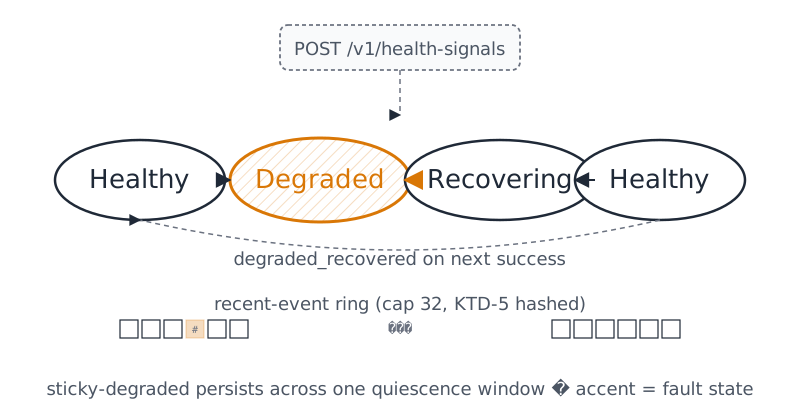
StickyDegradedplusDegradedSinceand a closed-setReasonsvocabulary (see below). The flag persists across at least one quiescence interval after the last fault; the next observed success emitsmetabolism.action degraded_recoveredand clears the flag. - Action × outcome histogram — bounded count matrix over the closed
MetabolismAction×Outcomeenums. - Recent-event ring — fixed-capacity (32) FIFO of metadata-only
RecentMetabolismEventrecords, hashed identifiers only.
flowchart TB
    subgraph inputs [Signal ingress]
        healthSignals["POST /v1/health-signals"]
    end
    subgraph controller [FleetController]
        fleetCtrl["Mode, cycles, actuations"]
    end
    subgraph observer [FleetRegulationObserver]
        fleetObs["Rules, aggregates, recommendations"]
    end
    subgraph snapshot [PostureSnapshot]
        sticky["Sticky-degraded flag"]
        histogram["Action x outcome histogram"]
        ring["Recent event ring cap 32"]
    end
    healthSignals --> fleetObs
    fleetObs --> fleetCtrl
    fleetCtrl --> snapshot
    fleetObs --> snapshot
Operator surfaces
Section titled “Operator surfaces”| Surface | Scope | Purpose |
|---|---|---|
bmo config show-fleet-metabolism (--format=text|json, --source=live|config) | fleet runtime | Headless posture envelope; prefers a loopback-safe live read and falls back to an explicit detached config-backed projection |
bmo config suggest-fleet-regulation | fleet runtime | Print a validated starter stanza for observe_only, recommend_only, or auto_apply without editing disk |
/fleet-metabolism (aliases /fleet_metabolism, /metabolism-posture, /metabolism_posture) | fleet runtime | Inline posture text in the chat transcript |
/metabolism | fleet runtime | Interactive Metabolism inspector dialog (cycle/recommendation viewer) |
Metabolism sidebar chip | fleet runtime | Live status badge from PostureSnapshot.State |
GET /v1/metabolism/posture | fleet runtime | JSON posture envelope over HTTP (requireAuth) |
The CLI posture surface is filed under config show-* for discoverability alongside
Run observability (bmo config show-run-observability).
Both families expose runtime truth through a config show-* entry point. For
fleet metabolism, detached reads stay explicit instead of collapsing into a
fake live failure: use --source=config when you want the config-backed view
even if a local runtime is available.
Agent and integration surfaces
Section titled “Agent and integration surfaces”| Surface | Scope | Purpose |
|---|---|---|
metabolism_posture | fleet runtime | Native agent read-only posture JSON |
list_recent_metabolism_events | fleet runtime | Native agent recent-ring read |
bmo_metabolism_posture | fleet runtime | MCP parity twin for cross-process agents |
Naming map
Section titled “Naming map”The product noun (Fleet runtime observability) differs from stable surface identifiers (legacy alias Fleet metabolism). Use this table when searching across layers:
| Layer | Name |
|---|---|
| Product noun (this page) | Fleet runtime observability |
| Legacy alias | Fleet metabolism — logs metabolism.*, package fleetmetabolism, parity row fleet_metabolism |
| Feature page slug / TUI slash | fleet-metabolism |
| HTTP route group | metabolism (/v1/metabolism/posture, control routes) |
| Agent / MCP tools | metabolism_posture, bmo_metabolism_posture |
The surface-parity matrix row fleet_metabolism (integration_surface in
docs/agent-native/surface-parity-matrix.yaml) is the maintainer index for
all aliases above.
Cross-surface parity
Section titled “Cross-surface parity”The same posture snapshot flows through CLI, slash, sidebar, agent tool, MCP,
and HTTP. A hub-composition smoke test asserts every surface emits the same JSON
(modulo captured_at), preventing formatter divergence across surfaces.
Every live surface reads the app-owned builder fleetmetabolism.BuildSnapshot.
That shared seam keeps HTTP, TUI, native tools, and MCP aligned without routing
through HTTP as an internal dependency.
Posture vocabulary
Section titled “Posture vocabulary”What the loop did (action × outcome)
Section titled “What the loop did (action × outcome)”MetabolismAction is bounded to: observe, recommend, auto_apply,
pause, unpause, mode_change, cycle, degraded_recovered.
Outcome is bounded to: ok, failed, timeout, canceled, skipped.
Why it is degraded (reason × error category)
Section titled “Why it is degraded (reason × error category)”Reasons is a closed PostureReason enum:
| Reason | Meaning |
|---|---|
controller_unreachable | FleetController manager is nil or returned a non-success status; runtime cannot read live mode/pause state |
config_absent | [options.fleet_regulation] is missing or the regulation section did not load; observer cannot fire rules |
policy_denied | A configured rule predicate failed the runtime policy gate (e.g. mode=observe_only with an auto_apply request) |
persistence_unhealthy | Controller or observer state-store write failed; sticky-degraded persists until a successful op clears it |
auto_apply_skipped_pending | An auto-apply rule matched but a prior actuation is still pending evaluation; the patch was deliberately skipped |
ErrorCategory is bounded to: rule_predicate_failed, patch_apply_failed,
patch_rejected, rate_limited, controller_missing, status_unavailable,
context_done, config_absent, policy_denied, pending (plus the empty
sentinel for ok outcomes).
Enable / pause workflow
Section titled “Enable / pause workflow”Generate a validated starter with:
bmo config suggest-fleet-regulation --mode observe_onlybmo config suggest-fleet-regulation --mode recommend_onlybmo config suggest-fleet-regulation --mode auto_apply --auto-apply-confirmed --shared-runtime --partition-id tenant-1Or author directly in bmo.toml:
[options.fleet_regulation]enabled = truemode = "observe_only"           # or "recommend_only", "auto_apply"
  [[options.fleet_regulation.recommend_rules]]  id = "high-error-rate-single-topology"    [options.fleet_regulation.recommend_rules.when]    api_error_rate_at_least = 0.15    [options.fleet_regulation.recommend_rules.recommend]    gene = "topology"    value = "single"
[options.fleet_controller]mode = "observe_only"           # disabled, observe_only, active, pausedinterval_seconds = 30
Mutate the live posture through the existing
runtime control routes:
POST /v1/metabolism/mode, POST /v1/metabolism/pause,
POST /v1/metabolism/unpause, and the agent-tool equivalents
(metabolism_set_mode, metabolism_pause, metabolism_unpause). These are
the only mutation routes; every other surface is read-only.
Fail-closed contract
Section titled “Fail-closed contract”When the loop cannot safely act, it never silently reports ok. It sets
sticky-degraded with a named Reason, records the skip on the histogram and
recent ring, and auto-recovers on the next successful cycle via
metabolism.action degraded_recovered.
The matrix below is the proof: these arms never fire auto_apply_* and
never advance the histogram into a misleading ok outcome.
stateDiagram-v2
    [*] --> healthy: nominal observe cycle
    healthy --> configAbsent: regulation section missing
    healthy --> controllerUnreachable: manager nil or status fail
    healthy --> policyDenied: auto_apply blocked by mode
    healthy --> persistenceUnhealthy: state-store write fail
    healthy --> pendingActuation: prior actuation still pending
    configAbsent --> stickyDegraded: Reasons += config_absent
    controllerUnreachable --> stickyDegraded: Reasons += controller_unreachable
    policyDenied --> stickyDegraded: Reasons += policy_denied
    persistenceUnhealthy --> stickyDegraded: Reasons += persistence_unhealthy
    pendingActuation --> stickyDegraded: Reasons += auto_apply_skipped_pending
    stickyDegraded --> healthy: degraded_recovered on next success
    state configAbsent:::blocked
    state controllerUnreachable:::blocked
    state policyDenied:::blocked
    state persistenceUnhealthy:::blocked
    state pendingActuation:::blocked
    classDef blocked stroke-dasharray:4 2
| Arm | Behavior |
|---|---|
[options.fleet_regulation] missing | observer is a no-op; emits metabolism.action observe outcome=skipped error_category=config_absent; posture Reasons includes config_absent |
| FleetController manager nil / unavailable | controller posture reports present=false; posture Reasons includes controller_unreachable; sticky-degraded set |
Mode is disabled or observe_only, request is auto_apply | observer emits metabolism.action auto_apply outcome=skipped error_category=policy_denied; no patch applied; posture Reasons includes policy_denied |
| Persistence write fails | sticky-degraded set with Reasons += persistence_unhealthy; clears on next success via metabolism.action degraded_recovered |
| Rule predicate matched but prior actuation pending | observer emits metabolism.action auto_apply outcome=skipped error_category=pending; posture Reasons includes auto_apply_skipped_pending |
Every gating decision lands on the recent ring (cap 32) with hashed
session_id_hash, rule_id_hash, and gene_hash. Raw session, request, or
rule identifiers never reach the log layer or the posture surfaces.
Tracing recipe
Section titled “Tracing recipe”Walk a fleet-metabolism cycle end-to-end without leaving the operator seat:
sequenceDiagram
    participant Operator
    participant TUI as TUI /fleet-metabolism
    participant CLI as bmo config show-fleet-metabolism
    participant Logs as bmo logs --tail
    participant Ring as Recent event ring

    Operator->>TUI: confirm controller and observer posture
    Operator->>CLI: same RenderPosture envelope headless
    Operator->>Logs: jq filter metabolism.* events
    Logs->>Ring: bounded FIFO metadata only
    Operator->>Logs: pair metabolism.fired with metabolism.action
    Note over Ring: session_id_hash correlates lifecycle pairs
/fleet-metabolism(TUI) orbmo config show-fleet-metabolism— confirm controller/observer state and sticky-degraded flag.- Tail recent events:
Terminal window bmo logs --tail 1000 | jq -c 'select(.msg|startswith("metabolism."))' - Filter the failure arms only:
Terminal window bmo logs --tail 1000 \| jq -c 'select(.msg=="metabolism.action" and (.outcome=="failed" or .outcome=="timeout"))' - Pair
metabolism.fired→metabolism.actionbysession_id_hashfor the full action lifecycle:Terminal window bmo logs --tail 2000 \| jq -c 'select(.msg|startswith("metabolism."))' \| jq -s 'group_by(.session_id_hash) | map({session_id_hash: .[0].session_id_hash, events: map({msg, action, outcome, error_category, rule_id_hash, gene_hash, latency_ms})})' - If
Reasonsincludespersistence_unhealthy, the next successful observe/cycle will emitmetabolism.action action=degraded_recovered outcome=okand clear the sticky flag automatically.
The full recipe lives in agent tracing recipes and is fixture-validated in the regression suite.
Current posture
Section titled “Current posture”Fleet runtime observability is read-only by default, with mutation limited to the explicitly armed control routes above:
- Every surface (CLI, slash, sidebar, agent tool, MCP, HTTP) emits the same posture snapshot, verified for JSON parity.
- The fail-closed contract holds across all five arms.
- The surface-parity matrix reports no divergent renderers.
The operator-facing surface documented here is the observable/read-only loop plus explicitly armed actuation paths.
Related
Section titled “Related”- Run observability — sibling runtime-observability family (session-scoped).
- Run ledger — paired posture/ring pattern donor.
- Agent mesh —
mesh.fired/.actionpattern donor. - Fleet runtime observability parity matrix (topic) — maintainer-facing v0/v1/v2 signal flow and ADM split callout.
- Tracing recipes —
metabolism.*recipe block. - Tools reference