Proof gallery
This gallery separates a conceptual system map from documented scenarios in the docs pipeline: live captures on feature pages (linked below) and live evaluate captures for headless CI, MCP export posture, and workspace claims on this page.
Use it during evaluation to inspect what has been demonstrated and what remains a proposed integration.
Conceptual system map
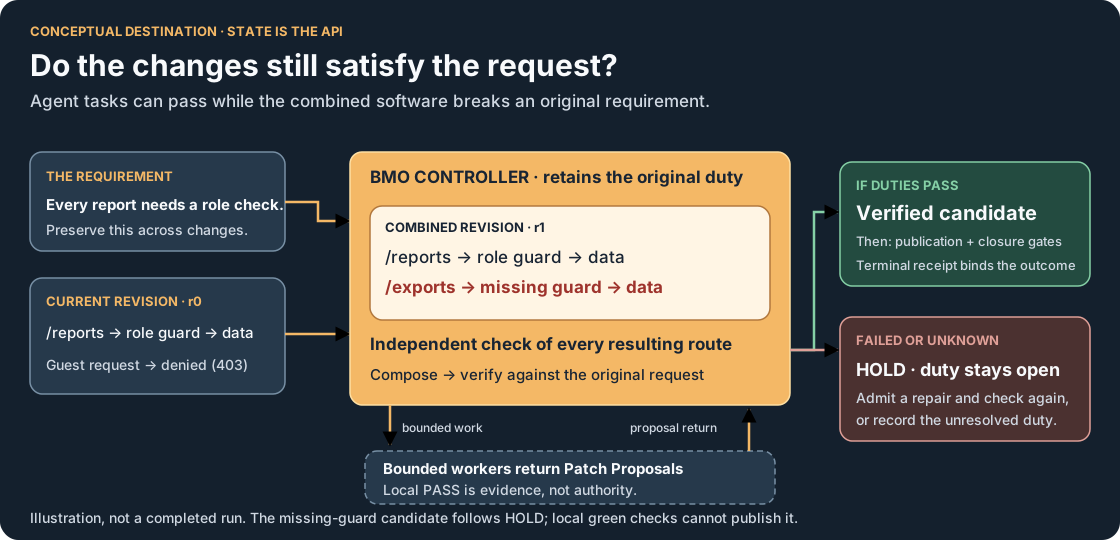
Section titled “Conceptual system map”The diagrams below describe the intended governed synthesis loop. They are editable SVG diagrams, not live captures or proof that all boundaries work together today. The selected local/Cloud Run delegated-work envelope and the held-path recording below are narrower accepted evidence. Broader integrated synthesis and an independent buyer-facing comparison belong to their delivery and evaluation owners.
Both patches pass. Together they skip a role check.
Section titled “Both patches pass. Together they skip a role check.”In the conceptual example, one worker adds /exports, calling a shared function
that checks the user’s role. Another worker moves that guard into the existing
/reports route. Each change passes against the baseline; combined, /exports
bypasses the guard. An independent guest-request check exposes the gap.
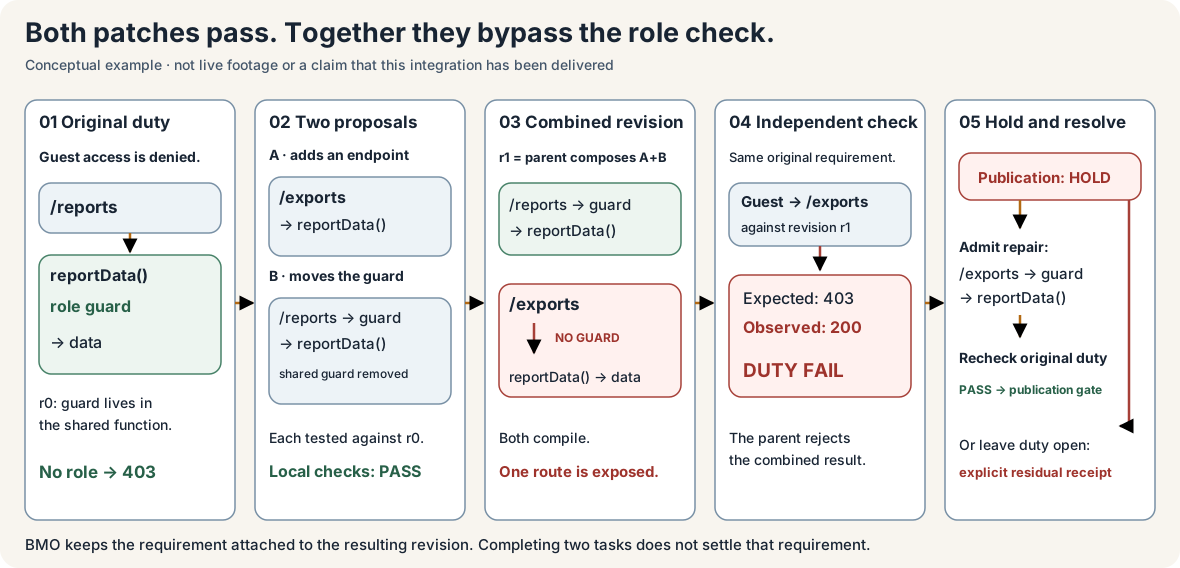
This is an illustration, not a completed run. BMO’s proposed loop retains the original requirement while an admitted repair is checked again, or records the unresolved duty. A verified candidate still needs separate publication and terminal closure gates.
Who can decide what?
Section titled “Who can decide what?”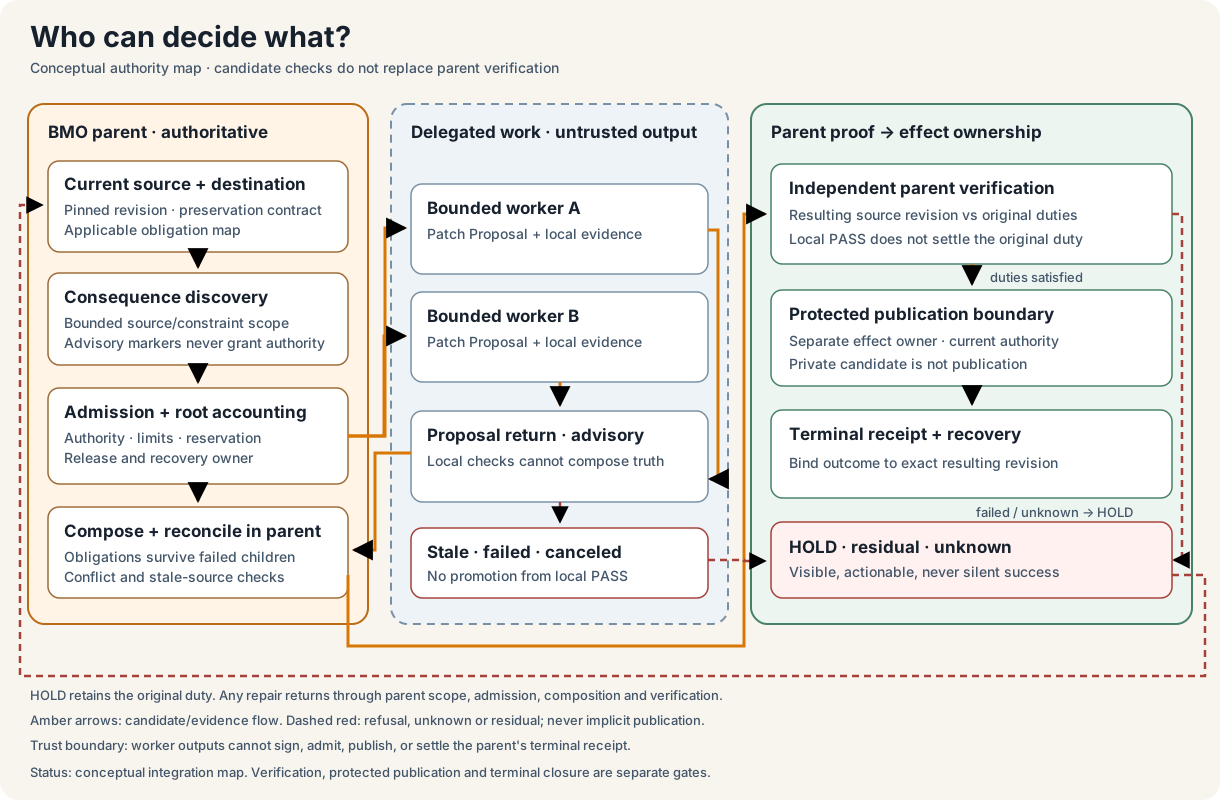
Workers return proposals to the parent. Stale, failed or canceled work cannot promote itself from local PASS. The independent parent check can also fail or remain unknown: that path returns to HOLD and the retained requirement. Protected publication and the terminal receipt have separate owners and gates.
Governed synthesis evidence map
Section titled “Governed synthesis evidence map”The diagrams above are a conceptual sketch. SIGNIN-204, below, is a separate historical sign-in fixture. Neither one is a receipt for decision-guided synthesis. This table maps each public claim to the evidence that actually supports it.
| Concept on this page | What is established | Where to read it |
|---|---|---|
| Storyboard and authority map | Illustration of a proposed loop. Not a live capture and not a passing test of the combined boundaries. | The SVG files linked above. |
| SIGNIN-204 | Archived sign-in fixture: a missing password guard, a failing check, a scoped repair, a passing rerun. Raw console logs are not in the archive. | The pinned revision links in Recorded scenario evidence. |
bmo synthesize ranking | Declared candidates, observed failure_loss, and a Patch Proposal at ready_for_human. | Decision-guided software synthesis. |
| Apply fence | Measured bytes must still match at apply. A changed candidate is refused. | Same guide, section “What apply is allowed to write”. |
| Parent check after a passing candidate check | The parent obligation stays pending through apply and can then fail without rolling the proposal back. | Same guide, unsuccessful path. |
| Coordinator acceptance | A provisioned decide-coordinator-outcome receipt with an empty residual list. Ordinary bmo synthesize does not write it. | Parent outcome. |
Bounded operator command
Section titled “Bounded operator command”The diagrams above stay conceptual. A separate, implemented command evaluates a specification you write and retains a reviewable proposal:
- Decision-guided software synthesis — ranking, proposal, aftercare, and the parent check, with the tests that establish each step.
- Change synthesis —
bmo synthesize inspect,limits,run,compose, andimport-local. Selection does not apply files. - Independent verification — declared checks and parent evidence are different records from a run’s verdict grade.
- Parent outcome —
bmo protected-admission decide-coordinator-outcomeon a provisioned controller. Ordinary local sessions do not record this receipt. - Mutation aftercare — the change-contract ingest after a reserved effect. It is not git auto-checkpoint.
That command path does not execute the storyboard, does not establish
autonomous decomposition, and does not establish general software synthesis.
A candidate_ready proposal still needs operator accept and apply. Parent
acceptance still needs the controller command and an empty residual list.
Recorded scenario evidence
Section titled “Recorded scenario evidence”The held-path recording illustrates SIGNIN-204, a bounded deterministic
sign-in fixture. Its archived receipt records a missing password guard, the
failing check, a scoped repair, the identical passing rerun, and preservation of
the adjacent fixture work. It does not establish autonomous decomposition or
general software synthesis. It is not a demonstration of decision-guided
bmo synthesize selection. The penalty ranking, aftercare, and parent-check
failure are on
Decision-guided software synthesis.
Command syntax stays on Change synthesis.
The following links pin the evidence package to its preserved revision:
- Scenario receipt (JSON): exact commands, results, source hashes and log hashes.
- Live TUI capture record: captured binary version, source pixels and limits. The capture pair alone does not prove the full edit chronology or adjacent-work preservation.
- Archived media manifest and matching archival recording: rendered-output provenance for that archive.
- Original fixture and reproduction contract and archived proof and claims guide.
The receipt preserves log hashes, but the raw failure, rerun and integration log files are absent from this archive. Its recorded results can be inspected; the original console output cannot be independently compared here.
The current walkthrough was rendered later. Its bytes do not match these archived manifests. Use the matching archival recording when checking those digests; the archive is historical scenario evidence, not a fresh qualification of the current binary. A receipt connects an outcome to its source and checks; a video is a presentation of that evidence.
Watch the current walkthrough or run your first local session.
Bounded proof slice — fix failing tests
Section titled “Bounded proof slice — fix failing tests”
Failing tests → one bmo run → fix lands in your editor and tests pass.
This is an existing bounded proof slice. The conceptual system map
and the recorded walkthrough are separate from this example.
Interactive review and planning
Section titled “Interactive review and planning”| Scenario | Evidence |
|---|---|
| Staged workflow plan gate | Staged workflow — plan review capture |
| Arena model comparison | Arena — comparison round capture |
| Quality gate verdict | Quality gates — judge flow capture |
Observability and recovery
Section titled “Observability and recovery”| Scenario | Evidence |
|---|---|
| Agent debugger run list | Agent debugger — /debugger capture |
| Run observability summary | Run observability — session summary |
| Multi-agent workspace claims | Multi-Agent Workflows — claims inspector |
Headless and integration (live captures)
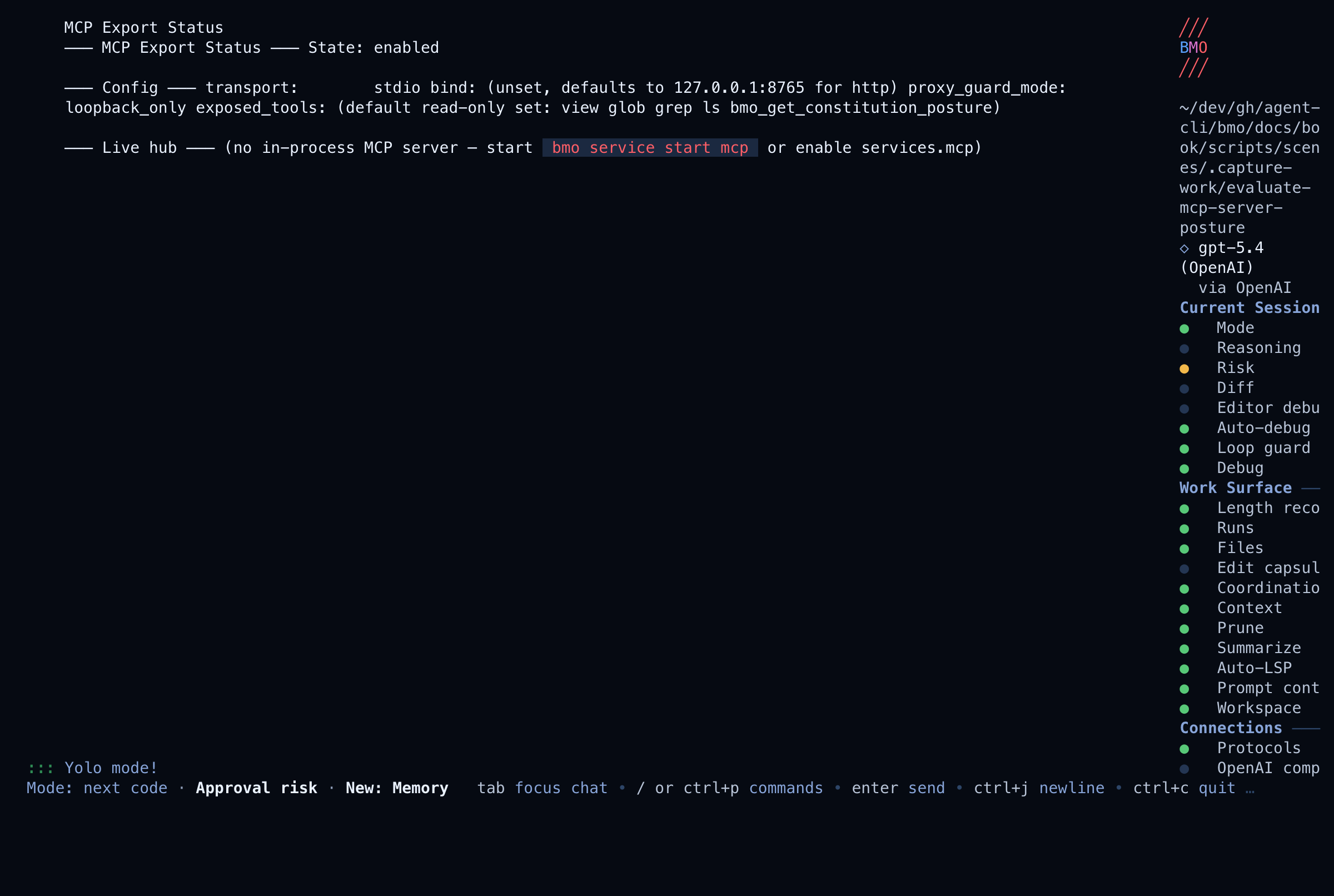
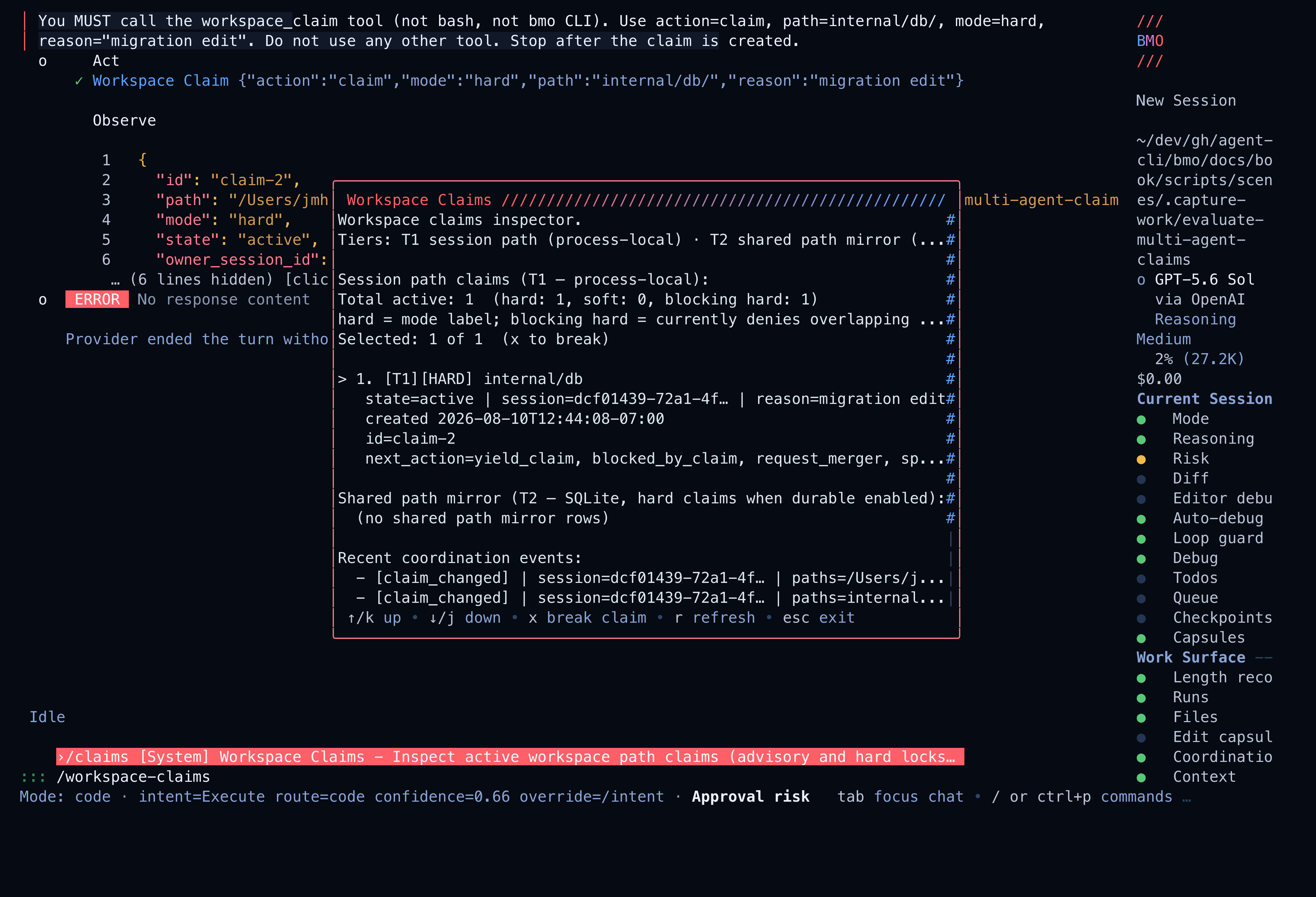
Section titled “Headless and integration (live captures)”These three captures are live tmux PNGs from the real ./bmo binary (provider
credentialed via the workspace .env wrapper).
| Scenario | Evidence |
|---|---|
| Headless CI run | Live bmo run --quiet log output below |
| MCP server defaults | Live /serve-mcp export status below |
| Multi-agent workspace claims | Live /workspace-claims table below — when setup acquires a hard claim on internal/db/, the table shows Total active: 1 and blocking hard: 1 (see Multi-Agent Workflows for hard vs blocking-hard semantics) |
The claims shot depends on a credentialed provider setup turn calling the
workspace_claim tool; if that turn does not land, the table may show zero active
claims even though the inspector surface is live.

What a healthy run looks like
Section titled “What a healthy run looks like”In the debugger, a completed solo turn typically shows:
- A run row in the session family list
- Ordered events: prompt assembly → tool calls → terminal status
- No unexplained
degradedposture on linked status surfaces
See Agent debugger — healthy run.
Related
Section titled “Related”- Decision-guided software synthesis — evidence-backed lifecycle behind the conceptual map
- Change synthesis — command reference for that lifecycle
- Why BMO
- Decision guide
- Performance — latency evidence